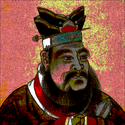
Confucius
Confucius: A Timeless Sage
Full Name and Common Aliases
Confucius, known in Chinese as Kong Fuzi or Kong Qiu, is one of the most influential philosophers in Chinese history. His Latinized name, Confucius, is derived from the honorific title "Kong Fuzi," meaning "Master Kong."
Birth and Death Dates
Confucius was born on September 28, 551 BCE, in the state of Lu, which is in present-day Shandong Province, China. He passed away on April 11, 479 BCE.
Nationality and Profession(s)
Confucius was a Chinese philosopher, teacher, and political figure. He is best known for his teachings and philosophy, which have deeply influenced Chinese culture and other East Asian societies.
Early Life and Background
Confucius was born into a period of political turmoil and social change during the late Zhou Dynasty. His family, though of noble descent, had fallen on hard times. His father, Kong He, died when Confucius was just three years old, leaving his mother, Yan Zhengzai, to raise him in poverty. Despite these challenges, Confucius was determined to pursue education and self-improvement. He was largely self-taught, immersing himself in the study of ancient texts and traditions.
From a young age, Confucius displayed a keen interest in learning and a deep respect for traditional values. His early experiences of hardship and his exposure to the instability of his times profoundly shaped his worldview and later teachings.
Major Accomplishments
Confucius's major accomplishments lie in his development of a comprehensive ethical and philosophical system known as Confucianism. He sought to restore social harmony and order through the cultivation of virtue and moral integrity. Confucius emphasized the importance of education, family loyalty, respect for elders, and the cultivation of moral character.
During his lifetime, Confucius held various government positions, including that of a magistrate and a minister of crime in the state of Lu. However, his political career was often hindered by the corruption and intrigue of the time. Despite these setbacks, Confucius continued to teach and gather disciples, spreading his ideas throughout the region.
Notable Works or Actions
Confucius did not write any books himself, but his teachings were compiled by his disciples in a collection known as the Analects. This work is a compilation of his sayings and ideas, capturing the essence of his philosophy. The Analects have been studied and revered for centuries, serving as a foundational text for Confucian thought.
In addition to the Analects, Confucius's influence extended to the editing and preservation of classical Chinese texts, including the Book of Songs, the Book of Documents, and the Spring and Autumn Annals. These works are considered part of the Confucian canon and have played a significant role in shaping Chinese literature and history.
Impact and Legacy
Confucius's impact on Chinese society and culture is immeasurable. His teachings became the cornerstone of Chinese education and governance for over two millennia. Confucianism was adopted as the official state ideology during the Han Dynasty, and its principles continued to guide Chinese society through subsequent dynasties.
Confucius's emphasis on moral education, filial piety, and social harmony has left a lasting legacy not only in China but also in other East Asian countries such as Korea, Japan, and Vietnam. His ideas have influenced various aspects of life, including politics, education, and family structure.
Why They Are Widely Quoted or Remembered
Confucius is widely quoted and remembered for his profound insights into human nature and society. His teachings offer timeless wisdom on how to live a virtuous and harmonious life. Confucius's emphasis on ethical behavior, respect for others, and the importance of education resonates with people across cultures and generations.
His aphorisms, such as "Do not impose on others what you do not wish for yourself" and "Real knowledge is to know the extent of one's ignorance," continue to inspire and guide individuals seeking personal growth and understanding. Confucius's ability to articulate complex ideas in simple, relatable terms has ensured that his words remain relevant and accessible to this day.
In a world often marked by conflict and division, Confucius's vision of a society built on mutual respect, empathy, and moral integrity offers a compelling blueprint for achieving peace and harmony. His enduring legacy as a teacher and philosopher ensures that his voice will continue to be heard and valued for generations to come.
Quotes by Confucius
Confucius's insights on:

Tell me and I will forget. Show me and I will remember. Involve me and I will understand.


When you see a good person, think of becoming like him. When you see someone not so good, reflect on your own weak points.

The way of a superior man is threefold: virtuous, he is free from anxieties; wise, he is free from perplexities; bold, he is free from fear.

A gentleman can see a question from all sides without bias.The small man is biased and can see a question only from one side.

Without an acquaintance with the rules of propriety, it is impossible for the character to be established.