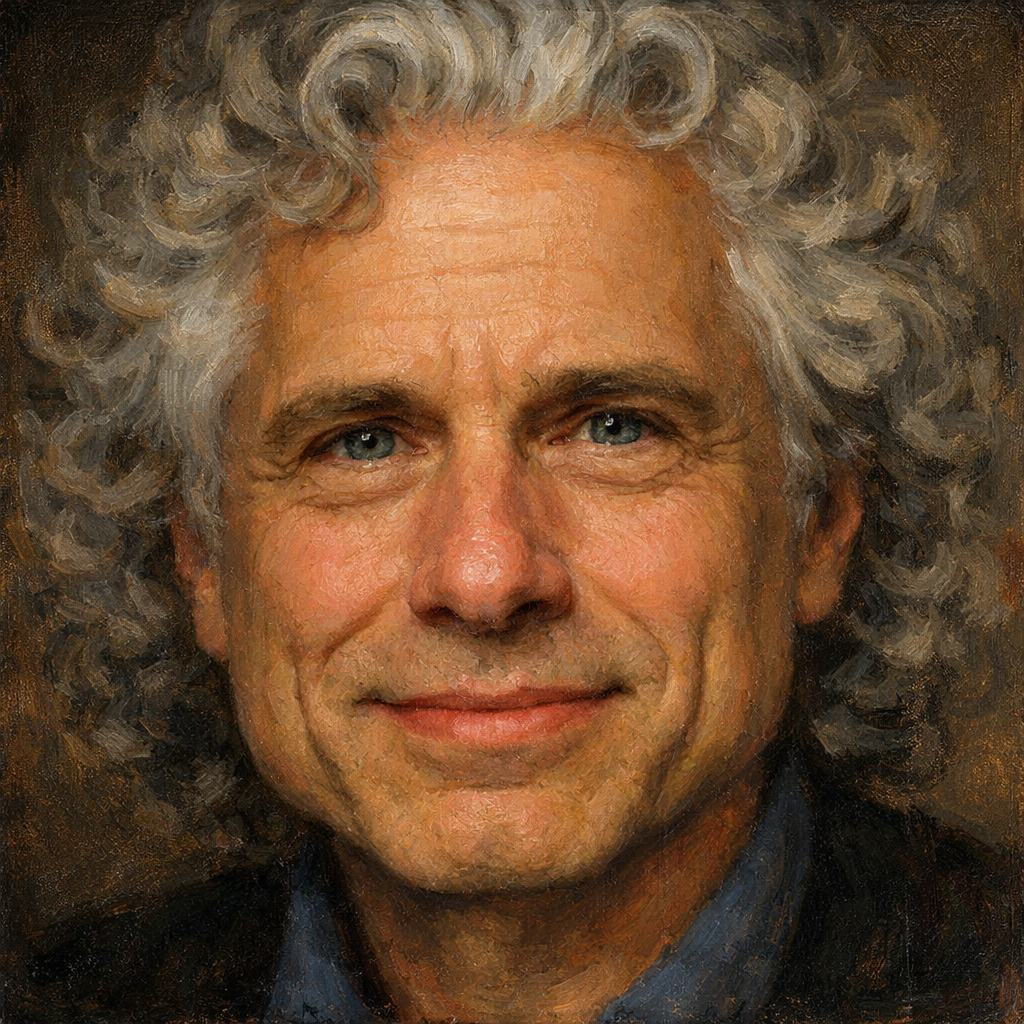
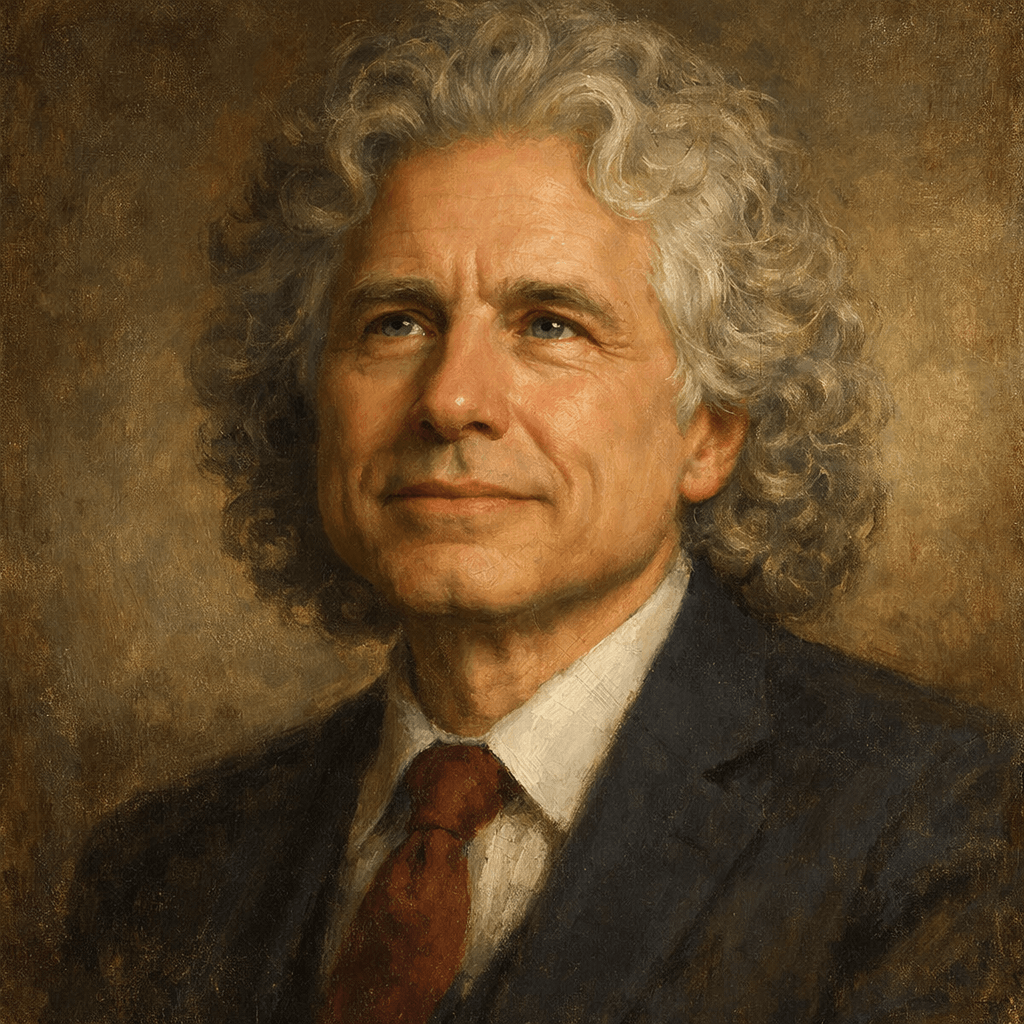
About Steven Pinker
Steven Pinker is a Canadian-American psychologist, cognitive scientist, and public intellectual, born on January 19, 1954, in Montreal, Canada. A professor at Harvard University, he has gained international acclaim for his groundbreaking work in linguistics, psychology, and the science of human nature.
Pinker’s research focuses on language acquisition, cognitive development, and the evolution of human behavior. His seminal books, including The Language Instinct (1994), How the Mind Works (1997), and The Better Angels of Our Nature (2011), have reshaped public understanding of topics like violence, morality, and rationality. In The Better Angels of Our Nature, he argues that humanity has become less violent over time, a thesis derived from rigorous historical data analysis. A vocal advocate for Enlightenment values, Pinker challenges political correctness and emphasizes the power of reason, science, and humanism to improve society.
Pinker’s work bridges academic research and public discourse, making complex ideas accessible to broad audiences. His historical analysis of declining violence and advocacy for evidence-based thinking have sparked global debates about progress and human potential. Today, his ideas remain vital in combating misinformation, fostering critical thinking, and addressing societal challenges through rational dialogue. In an era of polarization, Pinker’s defense of science and humanism offers a roadmap for navigating modern complexities with clarity and optimism.
150 Best Quotes by Steven Pinker
Steven Pinker, a luminary in psychology, linguistics, and cognitive science, has spent decades unraveling the complexities of human nature, language, and progress. His work bridges the gap between scientific rigor and accessible insight, earning him accolades as a public intellectual and a best-selling author of seminal works like The Better Angels of Our Nature and The Language Instinct. With a rare blend of wit, empathy, and intellectual curiosity, Pinker challenges misconceptions about human behavior, advocates for reason, and illuminates the forces shaping our world. His quotes are not just observations—they are invitations to rethink assumptions and embrace evidence-based perspectives on humanity’s past, present, and future.
This curated collection distills Pinker’s wisdom into 150 thought-provoking quotes spanning themes like language, morality, violence, cognition, and the power of science. Whether he’s dissecting the evolution of human cooperation, celebrating the beauty of rationality, or demystifying the intricacies of the mind, Pinker’s words resonate with clarity and conviction. Readers will find reflections on the decline of violence, the ethical dilemmas of technology, the roots of human nature, and the enduring value of free will. More than a list, this compilation is a gateway to inspiration—a reminder that understanding ourselves and our world begins with curiosity, critical thinking, and a commitment to truth. Let these quotes spark your own journey toward enlightenment.
Table of Contents
- Language and Communication
- Violence and War
- Morality and Ethics
- Human Nature and Psychology
- Cognition and the Mind
- Science and Technology
- Society and Culture
- Evolution and Biology
- Philosophy and Reason
- History and Politics
- Conclusion
Language and Communication
Steven Pinker’s reflections on language and communication reveal a profound curiosity about how humans encode meaning, navigate ambiguity, and harness the power of words to shape thought. For Pinker, language is both a biological instinct and a cultural artifact, a bridge between the mind and the world. His quotes dissect its mechanics, metaphors, and marvels with equal rigor.
"If I were allowed to take just one book to the proverbial desert island, it might be a dictionary." - Steven Pinker
"In any case, e lengeege weth e smell nember ef vewels cen remeen quete expresseve, so we cannot conclude that a hominid with a restricted vowel space had little language." - Steven Pinker
"Thinking can not trade in metaphors directly. It must trade in a more basic currency that captures the abstract concepts shared by the metaphor and its topic ... while sloughing off the irrelevant bits." - Steven Pinker
Pinker’s analysis of language often bridges the tangible and the abstract, as seen in his exploration of metaphor and cognition.
"I think about how language works so I can best explain how language works." - Steven Pinker
"Plato said that we are trapped inside a cave and know the world only through the shadows it casts on the wall. The skull is our cave, and mental representations are the shadows." - Steven Pinker
"Computation has finally demystified mentalistic terms. Beliefs are inscriptions in memory, desires are goal inscriptions, thinking is computation, perceptions are inscriptions triggered by sensors, trying is executing operations triggered by a goal." - Steven Pinker
His work dissects the interplay between language, perception, and computational models of the mind.
"Chomsky is a pencil-and-paper theoretician who wouldn't know Jabba the Hutt from the Cookie Monster," - Steven Pinker
"In the speech sound wave, one word runs into the next seamlessly; there are no little silences between spoken words the way there are white spaces between written words. We simply hallucinate word boundaries when we reach the end of a stretch of sound that matches some entry in our mental dictionary." - Steven Pinker
"As you are reading these words, you are taking part in one of the wonders of the natural world. For you and I belong to a species with a remarkable ability: we can shape events in each other's brains with exquisite precision." - Steven Pinker
Pinker’s critiques of theoretical linguistics and his awe at the mechanics of speech underscore his dual focus on science and wonder.
"The audible signals people can produce are not a series of crisp beeps like on a touch-tone phone. Speech is a river of breath, bent into hisses and hums by the soft flesh of the mouth and throat." - Steven Pinker
"As far as the language instinct is concerned, the correlation between genes and languages is a coincidence. People store genes in their gonads and pass them to their children through their genitals; they store grammars in their brains and pass them to their children through their mouths. Gonads and brains are attached to each other in bodies, so when bodies move, genes and grammars move together. That is the only reason that geneticists find any correlation between the two." - Steven Pinker
"Keep in mind a bit of wisdom from the linguist Ann Farmer: 'It isn't about being right. It's about getting it right.'" - Steven Pinker
He dissects the physicality of speech and the tangled genealogy of language evolution, while advocating for practical clarity over ideological rigidity.
"Much of the joy of writing comes from shopping from the hundreds of thousands of words that English makes available." - Steven Pinker
"Sometimes it is not easy to find any words that properly convey a thought. When we hear or read, we usually remember the gist, not the exact words, so there has to be such a thing as a gist that is not the same as a bunch of words." - Steven Pinker
"So what's in a name? The answer, we have seen, is, a great deal. In the sense of a morphological product, a name is an intricate structure, elegantly assembled by layers of rules and lawful even at its quirkiest. And in the sense of a listeme, a name is a pure symbol, part of a cast of thousands, rapidly acquired because of a harmony between the mind of the child, the mind of the adult, and the texture of reality." - Steven Pinker
Pinker’s quotes capture the duality of language as both a structured system and a fluid, expressive tool, from the writer’s craft to the child’s acquisition of symbols.
Violence and War
In Steven Pinker’s exploration of human history, the themes of violence and war are central to understanding the trajectory of societal progress. Pinker argues that while violence is a persistent aspect of human nature, its decline over time reflects the impact of institutions, interdependence, and cultural shifts.
"As technology accumulates and people in more parts of the planet become interdependent, the hatred between them tends to decrease, for the simple reason that you can't kill someone and trade with him too." - Steven Pinker
"The main reason that violence correlates with low socioeconomic status today is that the elites and the middle class pursue justice with the legal system while the lower classes resort to what scholars of violence call 'self-help.'" - Steven Pinker
"Hobbes's analysis of the causes of violence, borne out by modern data on crime and war, shows that violence is not a primitive, irrational urge, nor is it a 'pathology' except in the metaphorical sense of a condition that everyone would like to eliminate. Instead, it is a near-inevitable outcome of the dynamics of self-interested, rational social organisms." - Steven Pinker
Pinker emphasizes the rational underpinnings of violence, challenging the notion of it as a purely instinctual or chaotic force.
"The one great universal in the study of violence is that most of it is committed by fifteen-to-thirty-year-old men." - Steven Pinker
"One-on-one revenge was common in foraging societies, and kin-against-kin blood feuds were common in tribal societies that had not been pacified by a colonial or national government, particularly if they had an exaggerated culture of manly honor." - Steven Pinker
"we enjoy the peace we find today because people in past generations were appalled by the violence in their time and worked to reduce it, and so we should work to reduce the violence that remains in our time." - Steven Pinker
"Instead of asking, 'Why is there war?' we might ask, 'Why is there peace?' We can obsess not just over what we have been doing wrong but also over what we have been doing right. Because we have been doing something right, and it would be good to know what, exactly, it is." - Steven Pinker
This cluster of quotes underscores Pinker’s focus on systemic change and the role of human agency in fostering peace.
"People today think of the world as a uniquely dangerous place. It’s hard to follow the news without a mounting dread of terrorist attacks, a clash of civilizations, and the use of weapons of mass destruction. But we are apt to forget the dangers that filled the news a few decades ago, and to be blasé about the good fortune that so many of them have fizzled out." - Steven Pinker
"One of the tragic ironies of the second half of the 20th century is that when colonies in the developing world freed themselves from European rule, they often slid back into warfare, this time intensified by modern weaponry, organized militias, and the freedom of young men to defy tribal elders." - Steven Pinker
"Since violence is largely a male pastime, cultures that empower women tend to move away from the glorification of violence and are less likely to breed dangerous subcultures of rootless young men." - Steven Pinker
"... nonstate conflicts kill far fewer people than conflicts that involve a government, perhaps a quarter as many. Again, this is not surprising, since governments almost by definition are in the violence business." - Steven Pinker
Pinker highlights the paradoxes of post-colonial conflict and the gendered dimensions of violence.
"The psychological components of war have not gone away—dominance, vengeance, callousness, tribalism, groupthink, self-deception" - Steven Pinker
"The whole point of international terrorism is to shock the world with the most horrific spectacle imaginable." - Steven Pinker
"I think that communism was a major force for violence for more than 100 years, because it was built into its ideology—that progress comes through class struggle, often violent. It led to the widespread belief that the only way to achieve justice was to hurry this dialectical process along, and allow the oppressed working classes to carry out their struggle against their bourgeois oppressors" - Steven Pinker
"The reason the United States is not so likely to invade Iran is precisely because of the lessons learned from Iraq. And conversely, the Iranian push towards nuclear capability is calculated to deter invasions like the kind deposing Saddam Husain." - Steven Pinker
These quotes reveal Pinker’s nuanced analysis of ideological, psychological, and geopolitical drivers of conflict.
Morality and Ethics
Steven Pinker’s reflections on morality and ethics weave together science, reason, and human fallibility to challenge dogma, question inherited assumptions, and advocate for principles grounded in empathy and evidence. His quotes reveal a consistent belief in the power of critical thinking to refine ethical systems and the dangers of conflating empirical truths with moral imperatives.
"I think moralistic science is bad for morals and bad for science." - Steven Pinker
"By exploring the political and moral colorings of discoveries about what makes us tick, we can have a more honest science and a less fearful intellectual milieu." - Steven Pinker
"Even evolutionary explanations of the traditional division of labor by sex do not imply that it is unchangeable, 'natural' in the sense of good, or something that should be forced on individual women or men who don’t want it." - Steven Pinker
Pinker emphasizes the need to separate scientific explanations of human behavior from moral prescriptions, advocating for intellectual honesty to avoid conflating empirical truths with ethical obligations.
"The collapse of communism and a recognition of its economic and humanitarian catastrophes took the romance out of revolutionary violence and cast doubt on the wisdom of redistributing wealth at the point of a gun." - Steven Pinker
"Equality is not the empirical claim that all groups of humans are interchangeable; it is the moral principle that individuals should not be judged or constrained by the average properties of their group." - Steven Pinker
"As many political writers have pointed out, commitment to political equality is not an empirical claim that people are clones." - Steven Pinker
His critiques of utopian violence and defense of equality as a moral principle underscore the importance of distinguishing group averages from individual worth.
"The foundation of individual rights is the assumption that people have wants and needs and are authorities on what those wants and needs are. If people's stated desires were just some kind of erasable inscription or reprogrammable brainwashing, any atrocity could be justified." - Steven Pinker
"Religious people today, compartmentalize their attitude to the Bible. They pay it lip service as a symbol of morality while getting their actual morality from more modern principles." - Steven Pinker
"Institutionalized torture in Christendom was not just an unthinking habit; it had a moral rationale. If you really believe that failing to accept Jesus as one's savior is a ticket to fiery damnation, then torturing a person until he acknowledges this truth is doing him the biggest favor of his life: better a few hours now than an eternity later." - Steven Pinker
Pinker challenges the dehumanizing logic of systemic violence, whether justified by religion or state power, and affirms the centrality of individual agency in ethics.
"The doctrine of a soul that outlives the body is anything but righteous, because it necessarily devalues the lives we live on this earth." - Steven Pinker
"The doctrine of the sacredness of the soul sounds vaguely uplifting, but in fact is highly malignant. It discounts life on earth as just a temporary phase that people pass through, indeed, an infinitesimal fraction of their existence…the gradual replacement of lives for souls as the locus of moral value was helped along by the ascendency of skepticism and reason." - Steven Pinker
"A great principle of moral advancement, on par with 'Love thy neighbor' and 'All men are created equal,' is the one on the bumper sticker: 'Shit happens.'" - Steven Pinker
Pinker critiques religious doctrines that diminish earthly life’s value and celebrates pragmatism and humility as pillars of ethical progress.
"As moral philosophers through the ages have pointed out, a philosophy of living based on 'Not everyone, just me!' falls apart as soon as one sees oneself from an objective standpoint as a person just like others. It is like insisting that 'here,' the point in space one happens to be occupying at the moment, is a special place in the universe." - Steven Pinker
"If some metaphors can persist in the language as fossils, it puts every metaphor under a cloud of suspicion." - Steven Pinker
"The history of human folly, and our own susceptibility to illusions and fallacies, tells us that men and women are fallible. One therefore ought to seek good reasons for believing something. Faith, revelation, tradition, dogma, authority, the ecstatic glow of subjective certainty - all are recipes for error, and should be dismissed as sources of knowledge." - Steven Pinker
Pinker’s final quotes highlight the universality of moral reasoning, the need for critical scrutiny of language, and the irreplaceable role of reason in countering superstition and error.
Human Nature and Psychology
Steven Pinker’s exploration of human nature and psychology intertwines evolutionary theory, cognitive science, and cultural critique. His quotes reveal a nuanced view of humanity—acknowledging our biological roots while emphasizing the potential for progress, empathy, and rationality.
"Apes have a wide variety of sexual arrangements. That means, by the way, that there is no such thing as an ‘ape legacy’ that humans are doomed to live by." - Steven Pinker
"Sex has high stakes, including exploitation, disease, illegitimacy, incest, jealousy, spousal abuse, cuckoldry, desertion, feuding, child abuse, and rape. These hazards have been around for a long time and have left their mark on our customs and our emotions." - Steven Pinker
"Sex and excretion are reminders that anyone's claim to round-the-clock dignity is tenuous. The so-called rational animal has a desperate drive to pair up and moan and writhe." - Steven Pinker
Pinker dissects the paradoxes of human behavior, showing how base instincts coexist with cultural norms and aspirations.
"The essence of a culture of honor is that it does not sanction predatory or instrumental violence, but only retaliation after an insult or other mistreatment." - Steven Pinker
"Organisms are selected to deploy violence only in circumstances where the expected benefits outweigh the expected costs." - Steven Pinker
"The researchers argued that an orderly environment fosters a sense of responsibility not so much by deterrence (since Groningen police rarely penalize litterers) as by the signaling of a social norm: This is the kind of place where people obey the rules." - Steven Pinker
These quotes underscore Pinker’s focus on rationality and the interplay between biology and social structures.
"The Darwinian approach to sex is often attacked as being antifeminist, but that is just wrong. Indeed, the accusation is baffling on the face of it, especially to the many feminist women who have developed and tested the theory. The core of feminism is surely the goal of ending sexual discrimination and exploitation, an ethical and political position that is in no danger of being refuted by any foreseeable scientific theory or discovery." - Steven Pinker
"Humans are ingenious at sniffing out minor differences to figure out whom they should despise." - Steven Pinker
"A bumper sticker from the 1970s read, ‘A woman without a man is like a fish without a bicycle.’" - Steven Pinker
Pinker’s critiques of misinformation highlight his commitment to bridging scientific understanding with social progress.
"There is no law of complex systems that says that intelligent agents must turn into ruthless conquistadors. Indeed, we know of one highly advanced form of intelligence that evolved without this defect. They're called women." - Steven Pinker
"The observation that conflict is part of the human condition, banal though it is, contradicts fashionable beliefs." - Steven Pinker
"We can see happiness as the output of an ancient biological feedback system that tracks our progress in pursuing auspicious signs of fitness in a natural environment. We are happier, in general, when we are healthy, comfortable, safe, provisioned, socially connected, sexual, and loved. The function of happiness is to goad us into seeking the keys to fitness." - Steven Pinker
These reflections reveal Pinker’s optimism about human potential and his grounding in evolutionary psychology.
"Evolutionarily speaking, there is seldom any mystery in why we seek the goals we seek — why, for example, people would rather make love with an attractive partner than get a slap on the belly with a wet fish." - Steven Pinker
"Some people think that evolutionary psychology claims to have discovered that human nature is selfish and wicked. But they are flattering the researchers and anyone who would claim to have discovered the opposite." - Steven Pinker
"Nature is a hanging judge," goes an old saying. Many tragedies come from our physical and cognitive makeup. Our bodies are extraordinarily improbable arrangements of matter, with many ways for things to go wrong and only a few ways for things to go right. We are certain to die, and smart enough to know it. Our minds are adapted to a world that no longer exists, prone to misunderstandings correctable only by arduous education, and condemned to perplexity about the deepest questions we can ascertain." - Steven Pinker
Pinker’s final trio of quotes encapsulates his holistic view: humanity is a blend of biological imperatives, cognitive limitations, and the enduring quest for meaning.
Cognition and the Mind
Steven Pinker’s work on cognition and the mind explores the intricate interplay between biology, evolution, and human thought. He examines how the mind functions as a biological organ, shaped by natural selection to solve ancestral problems, while also grappling with its limitations in seeking truth and understanding abstract concepts.
"The mind is a neural computer" - Steven Pinker
"The task of evolutionary psychology is not to weigh in on human nature, a task better left to others. It is to add the satisfying kind of insight that only science can provide: to connect what we know about human nature with the rest of our knowledge of how the world works, and to explain the largest number of facts with the smallest number of assumptions" - Steven Pinker
"It Begins with skepticism. The history of human folly, and our own susceptibility to illusions and fallacies, tell us that men and women are fallible" - Steven Pinker
Pinker’s early reflections on the mind emphasize its biological roots and the scientific rigor needed to dissect its complexities.
"…the mental organization of grammar is a case where complexity in the mind is not caused by learning; learning is caused by complexity in the mind" - Steven Pinker
"Humans are so innately hardwired for language that they can no more suppress their ability to learn and use language than they can suppress the instinct to pull a hand back from a hot surface" - Steven Pinker
"Conceptual metaphors point to an obvious way in which people could learn to reason about new, abstract concepts. They would notice, or have pointed out to them, a parallel between a physical realm they already understand and a conceptual realm that they don't yet understand. … They would be the mechanism that the mind uses to understand otherwise inaccessible concepts" - Steven Pinker
Here, Pinker contrasts innate cognitive structures with learned behaviors, particularly in language and abstract reasoning, highlighting the mind’s pre-programmed complexity.
"If the metaphors in everyday speech are a clue, then all of us associate blankness with virtue rather than with nothingness. Think of the moral connotations of the adjectives: clean, fair, immaculate, lily-white, pure, spotless, unmarred and unsullied" - Steven Pinker
"Of course genes can’t pull the levers of our behavior directly. But they affect the wiring and workings of the brain, and the brain is the seat of our drives, temperaments and patterns of thought" - Steven Pinker
"Friendship, like other kinds of altruism, is vulnerable to cheaters, and we have a special name for them: fair-weather friends" - Steven Pinker
Pinker delves into how cognitive biases and genetic influences shape not only individual behavior but also social dynamics, such as trust and moral reasoning.
"Much can be gained by contrasting a theory with its alternatives, even ones that look too extreme to be true. You can really understand something when you know what it is not" - Steven Pinker
"A…reason we are so-so scientists is that our brains were shaped for fitness, not for truth. Sometimes truth is adaptive, but sometimes it is not" - Steven Pinker
"We are organisms, not angels, and our minds are organs, not pipelines to the truth" - Steven Pinker
These quotes underscore Pinker’s critique of the human mind’s evolutionary limitations, emphasizing how survival-driven cognition often clashes with the pursuit of objective truth.
"You can only really understand something when you know what it is not" - Steven Pinker
"As with any form of mental self-improvement, you must learn to turn your gaze inward, concentrate on processes that usually run automatically, and try to wrest control of them so that you can apply them more mindfully" - Steven Pinker
"Language-lovers know that there is a word for every fear" - Steven Pinker
Pinker’s final reflections tie together the themes of self-awareness, linguistic precision, and the mind’s capacity for both clarity and fallibility.
Science and Technology
Steven Pinker’s work often intersects with science and technology, exploring how empirical inquiry reshapes our understanding of human nature, progress, and reality. He challenges intuitive assumptions with rigorous analysis, emphasizing evolution, cognition, and the interplay between scientific advancements and societal change.
"What could be more fundamental to our sense of meaning and purpose than a conception of whether the strivings of the human race over long stretches of time have left us better or worse off? How, in particular, are we to make sense of modernity—of the erosion of family, tribe, tradition, and religion by the forces of individualism, cosmopolitanism, reason, and science?" - Steven Pinker
"It's natural to think that living things must be the handiwork of a designer. But it was also natural to think that the sun went around the earth. Overcoming naive impressions to figure out how things really work is one of humanity's highest callings." - Steven Pinker
"A lot follows from the idea that the mind is a metaphor-monger." - Steven Pinker
These quotes reflect Pinker’s contemplation of humanity’s trajectory in a modern, science-driven world, balancing existential questions with scientific skepticism.
"The geometry of beauty is the visible signal of adaptively valuable objects: safe, food-rich, explorable, learnable habitats, and fertile, healthy dates, mates, and babies." - Steven Pinker
"The supposedly immaterial soul, we now know, can be bisected with a knife, altered by chemicals, started or stopped by electricity, and extinguished by a sharp blow or by insufficient oxygen." - Steven Pinker
"The stuff of life turned out to be not a quivering, glowing, wondrous gel but a contraption of tiny jigs, springs, hinges, rods, sheets, magnets, zippers, and trapdoors, assembled by a data tape whose information is copied, downloaded and scanned." - Steven Pinker
"The mind is not designed to grasp the laws of probability, even though the laws rule the universe." - Steven Pinker
These quotes delve into the biological and mechanistic underpinnings of life, illustrating how scientific discoveries reveal the non-magical, yet intricate, nature of existence.
"If a gene could build a brain that could tell when copies of itself were sitting in another animal's gonads, it would make the brain enjoy the other animal's well-being, and make it act in ways that increased that other animal's well-being." - Steven Pinker
"Semantics is about the relation of words to thoughts, but it also about the relation of words to other human concerns. Semantics is about the relation of words to reality—the way that speakers commit themselves to a shared understanding of the truth, and the way their thoughts are anchored to things and situations in the world." - Steven Pinker
"legal investigation. As Clinton noted, 'My goal in this deposition was to be truthful, but not particularly helpful.'" - Steven Pinker
Here, Pinker explores the intricate relationship between language, cognition, and reality, while also weaving in real-world examples to underscore cognitive and communicative complexities.
"The starting point for becoming a good writer is to be a good reader." - Steven Pinker
"We are going to die, and that makes us the lucky ones. Good writing starts strong. Not with a cliché ('Since the dawn of time'), not with a banality ('Recently, scholars have been increasingly concerned with the question of…'), but with a contenful observation that provokes curiosity." - Steven Pinker
"Lakoff is right to insist that conceptual metaphors are not just literary garnishes but aides to reason – they are 'metaphors we live by.' And metaphors can power sophisticated inferences, not just obvious ones…" - Steven Pinker
Finally, these quotes highlight the importance of clarity and precision in communication, a principle that underpins both scientific inquiry and effective writing.
Society and Culture
Steven Pinker’s reflections on society and culture delve into the intricate tensions between fairness, freedom, and equality, the evolution of governance, and the role of human nature in shaping cultural norms. His insights reveal how societies navigate the complexities of progress while grappling with the legacies of tradition, violence, and the enduring impact of human psychology.
"No society can be simultaneously fair, free, and equal. If it is fair, people who work harder can accumulate more. If it is free, people will give their wealth to their children. But then it cannot be equal, for some people will inherit wealth they did not earn." - Steven Pinker
"A sense of solidarity among fifteen-to-thirty-year-olds would be a menace to civilized society even in the best of times." - Steven Pinker
"A society is an organic system that develops spontaneously, governed by myriad interactions and adjustments that no human mind can pretend to understand. Just because we cannot capture its workings in verbal propositions does not mean it should be scrapped and reinvented according to the fashionable theories of the day. Such ham-fisted tinkering will only lead to unintended consequences, culminating in violent chaos." - Steven Pinker
"States are far less violent than traditional bands and tribes. Modern Western countries, even in their most war-torn centuries, suffered no more than around a quarter of the average death rate of nonstate societies, and less than a tenth of that for the most violent one." - Steven Pinker
Pinker’s early quotes underscore the paradoxes of societal design and the often-counterintuitive role of governance in reducing violence.
"As an Auyana man living in New Guinea under the Pax Australiana put it, 'Life was better since the government came' because 'a man could now eat without looking over his shoulder and could leave his house in the morning to urinate without fear of being shot.'" - Steven Pinker
"Much of what is today called 'social criticism' consists of members of the upper classes denouncing the tastes of the lower classes (bawdy entertainment, fast food, plentiful consumer goods) while considering themselves egalitarians." - Steven Pinker
"Though we tend to remember bad events as well as we remember good ones, the negative coloring of the misfortunes fades with time, particularly the ones that happened to us. We are wired for nostalgia: in human memory, time heals most wounds." - Steven Pinker
"A design can excel at one challenge only by compromising at others." - Steven Pinker
The tension between governance, class critique, and human memory highlights how cultural narratives are shaped by both structural realities and psychological biases.
"Today we recognize that the emotion of disgust evolved as an unconscious defense against biological contamination." - Steven Pinker
"We should expose whatever ends are harmful and whatever ideas are false, and not confuse the two." - Steven Pinker
"Many artists and scholars have pointed out that ultimately art depends on human nature." - Steven Pinker
"It looks as if the offspring have eyes so that they can see well (bad, teleological, backward causation), but that's an illusion. The offspring have eyes because their parents' eyes did see well (good, ordinary, forward causation)." - Steven Pinker
Pinker’s observations on disgust, truth, art, and evolution illustrate how cultural expressions and moral judgments are deeply rooted in biological imperatives.
"As people age, they confuse changes in themselves with changes in the world, and changes in the world with moral decline—the illusion of the good old days. And so every generation believes that the kids today are degrading the language and taking civilization down with it." - Steven Pinker
"I have never killed a man, but I have read many obituaries with great pleasure." - Steven Pinker
His final quotes juxtapose the universal nostalgia of aging with a wry acknowledgment of human mortality, capturing the duality of societal critique and dark humor.
Evolution and Biology
Steven Pinker’s work on evolution and biology explores the intricate ways in which human cognition, behavior, and societal structures are shaped by evolutionary processes. His insights often bridge biological imperatives with modern psychological and cultural complexities, offering a lens to understand both our adaptive past and the challenges of contemporary life.
"The idea that boys want to sleep with their mothers strikes most men as the silliest thing they have ever heard. Obviously, it did not seem so to Freud, who wrote that as a boy he once had an erotic reaction to watching his mother dressing. But Freud had a wet-nurse, and may not have experienced the early intimacy that would have tipped off his perceptual system that Mrs. Freud was his mother. The Westermarck theory has out-Freuded Freud." - Steven Pinker
"Matthew White, a self-described atrocitologist who keeps a database with the estimated death tolls of history’s major wars, massacres, and genocides, counts about 1.2 million deaths from mass killing that are specifically enumerated in the Bible. (He excludes the half million casualties in the war between Judah and Israel described in 2 Chronicles 13 because he considers..." - Steven Pinker
"Human vice is proof that biological adaption is, speaking literally, a thing of the past. Our minds are adapted to the small foraging bands in which our family spent ninety-nine percent of its existence, not the topsy-turvy contingencies we have created since the agricultural and industrial revolutions....People do not divine what is adaptive for them or their genes; their genes give them thoughts and feelings that were adaptive in the environment in which the genes were selected." - Steven Pinker
These quotes underscore Pinker’s exploration of how evolutionary psychology shapes human instincts, from familial bonds to moral reasoning, often clashing with modern societal norms.
"Nothing invests life with more meaning than the realisation that every moment of sentience is a precious gift" - Steven Pinker
"the mind is a metaphor-monger" - Steven Pinker
"Combinatorics allow a finite set of simple ideas to give rise to an Infinite set of complex ones." - Steven Pinker
Pinker frequently highlights the mind’s capacity for metaphor and abstraction, framing these as evolutionary adaptations that enable human creativity and problem-solving.
"The age distribution of a population changes slowly, as each demographic pig makes its way through the population python." - Steven Pinker
"The fact that mean measures of environmental quality are improving does not mean that everything is ok. That the environment got better by itself or that we can just sit back and relax for the cleaner environment that we enjoy today, we must thank the arguments, activism, legislation, regulation, treaties and technological ingenuity of the people who sought to improve it in the past." - Steven Pinker
"The urban planner Donald Sean has argued that an ‘urban blight’ metaphor led planners to treat crowded neighbourhoods as if they were diseased plants, which had to be extirpated to prevent the spread of rot. The result was the disastrous urban renewal projects the 1960s." - Steven Pinker
Here, Pinker connects evolutionary principles to environmental and societal shifts, emphasizing how human agency and metaphorical thinking influence progress and missteps.
"…at the other end of the shelf, the ubiquity of metaphor in everyday language is truly a surprising discovery, rich with implications. Even the killjoy has to admit that metaphors were alive in the minds of the original coiners and compelling to the early adopters." - Steven Pinker
"The flexibility of the human mind - its ability to flip frames, shift gestalts, or reconstruct events – is a wondrous talent. But it makes it difficult to predict how person will think and talk about a given situation. When I hit a wall with the stick, am I affecting the stick by moving it to the wall, or affecting the wall using the stick as an instrument?" - Steven Pinker
"If a gene could build a brain that could tell when copies of itself were sitting in another animal's gonads, it would make the brain enjoy the other animal's well-being, and make it act in ways that increased that other animal's well-being." - Steven Pinker
These reflections reveal Pinker’s fascination with the mind’s adaptive complexity and the evolutionary logic behind social behaviors, even as they complicate our understanding of causality and altruism.
"Dear White Fella When I am born I’m black When I grow up I’m black When I am sick I’m black When I go out ina sun I’m black When I git cold I’m black When I git scared I’m black And when I die I’m still black. But you white fella When you’re born you’re pink When you grow up you’re white When you git sick you’re green When you go out ina sun you go red When you git cold you go blue When you git scared you’re yellow And when you die you’re grey And you got the cheek to call me coloured?" - Steven Pinker
"Nature is a hanging judge," goes an old saying. Many tragedies come from our physical and cognitive makeup. Our bodies are extraordinarily improbable arrangements of matter, with many ways for things to go wrong and only a few ways for things to go right. We are certain to die, and smart enough to know it. Our minds are adapted to a world that no longer exists, prone to misunderstandings correctable only by arduous education, and condemned to perplexity about the deepest questions we can ascertain." - Steven Pinker
"The reason the United States is not so likely to invade Iran is precisely because of the lessons learned from Iraq. And conversely, the Iranian push towards nuclear capability is calculated to deter invasions like the kind deposing Saddam Husain." - Steven Pinker
Pinker’s quotes on identity, mortality, and geopolitics illustrate how evolutionary biology intersects with cultural narratives and strategic decision-making, often yielding paradoxes and unintended consequences.
Philosophy and Reason
Steven Pinker’s philosophical reflections often intersect with empirical science, exploring how reason, language, and cognitive evolution shape human progress. His insights bridge abstract thought with tangible evidence, revealing the interplay between rationality, metaphor, and the pursuit of a better world.
"So holding many factors constant, we find that living in a civilization reduces one’s chances of being a victim of violence fivefold." - Steven Pinker
"The violence of a lower-class man may indeed express rage, but it is aimed not at society but at the asshole who scraped his car and dissed him in front of a crowd." - Steven Pinker
"They are distinct enough that our crude instruments can pick up the differences, yet both are healthy instances of that staggeringly improbable, exquisitely engineered system we call a human being." - Steven Pinker
"We will never have a perfect world, but it’s not romantic or naïve to work toward a better one." - Steven Pinker
Pinker’s early quotes juxtapose societal progress with human behavior, emphasizing how civilization reduces violence while individual actions remain rooted in concrete, often petty, motivations.
"Burr would not be the last vice president to shoot a man, but he was a better shot than Dick Cheney," - Steven Pinker
"In the speech sound wave, one word runs into the next seamlessly; there are no little silences between spoken words the way there are white spaces between written words. We simply hallucinate word boundaries when we reach the end of a stretch of sound that matches some entry in our mental dictionary." - Steven Pinker
"That’s right: when it comes to correct English, there’s no one in charge; the lunatics are running the asylum." - Steven Pinker
"If we dig even deeper to the roots of words, we unearth physical metaphors for still more abstract concepts." - Steven Pinker
Here, Pinker dissects language’s fluidity, illustrating how perception and metaphor underpin communication, while also critiquing the chaos of linguistic authority.
"Given these payoffs, endorsing a belief that hasn't passed muster with scientific and fact checking isn't so irrational after all, at least not by the criterion of the immediate affects on the believer. The affects on the society and planet are another matter." - Steven Pinker
"Moving from philosophy to psychology, we discover a big problem with the claim that most of our thinking is metaphorical: people effortlessly transcend the metaphors implicit in their language." - Steven Pinker
"...you have to acknowledge the possibility that generative metaphors are a major phenomenon in language and an important clue to our cognitive makeup. Abstract ideas are connected in a systematic way to more concrete experiences." - Steven Pinker
"What is truly arresting about our kind is better captured in the story of the Tower of Babel, in which humanity, speaking a single language, came so close to reaching heaven that God himself felt threatened." - Steven Pinker
Pinker’s exploration of metaphor highlights the tension between cognitive frameworks and human capacity to transcend them, while invoking myth to underscore humanity’s ambitious, unifying drive.
"By failing to take note of the gifts of modernity, social critics poison voters against responsible custodians and incremental reformers who can consolidate the tremendous progress we have enjoyed and strengthen the conditions that will bring us more." - Steven Pinker
"Complex organs evolve by small steps for the same reason that a watchmaker does not use a sledgehammer and a surgeon does not use a meat cleaver." - Steven Pinker
"The quotation falsely attributed to Stalin, 'One death is a tragedy; a million deaths is a statistic,' gets the numbers wrong but captures a real fact about human psychology." - Steven Pinker
These quotes tie evolution, progress, and psychology to societal critique, arguing for incrementalism and the recognition of how cognitive biases shape our perception of scale and moral urgency.
History and Politics
Steven Pinker’s reflections on history and politics often intertwine with his analyses of human cognition, violence, and institutional evolution. His quotes in this section reveal a nuanced perspective on how political structures, historical trends, and cognitive processes shape—and are shaped by—human societies.
"One of the tragic ironies of the second half of the 20th century is that when colonies in the developing world freed themselves from European rule, they often slid back into warfare, this time intensified by modern weaponry, organized militias, and the freedom of young men to defy tribal elders." - Steven Pinker
"Though bad writing has always been with us, the rules of correct usage are the smallest part of the problem." - Steven Pinker
"Those who cannot remember the past are condemned to compute it." - Steven Pinker
Pinker’s early quotes highlight the paradoxes of post-colonial violence, the limitations of linguistic rules, and the necessity of historical memory in shaping political futures.
"As far as the language instinct is concerned, the correlation between genes and languages is a coincidence." - Steven Pinker
"Chomsky's writings are 'classics' in Mark Twain's sense: something that everybody wants to have read and nobody wants to read." - Steven Pinker
"Outwitting and second-guessing an organism of approximately equal mental abilities with non-overlapping interests, at best, and malevolent intentions, at worst, makes formidable and ever-escalating demands on cognition." - Steven Pinker
"When it comes to correct English, there's no one in charge; the lunatics are running the asylum." - Steven Pinker
These quotes dissect the interplay between biology, language, and political thought, while critiquing intellectual fads and linguistic authority.
"Can reason lead us in directions that are good or decent or moral?" - Steven Pinker
"Once we have isolated the computational and neurological correlates of access-consciousness, there is nothing left to explain." - Steven Pinker
"The typical imperative from biology is not 'Thou shalt... ,' but 'If ... then ... else." - Steven Pinker
"What’s going on? On the one hand, analogical thinking seems to be our birthright... On the other hand, when experimentalists lead the horse to water, they can’t make it drink." - Steven Pinker
Pinker grapples with reason’s moral limits, the nature of consciousness, and the tension between innate cognitive patterns and their practical application in politics and science.
"Knights do protect ladies, but only to keep them from being abducted by other knights." - Steven Pinker
"The dominant theories of elite art and criticism in the 20th century grew out of a militant denial of human nature." - Steven Pinker
"In the foreign country, we call the past, crucifixion was a common punishment. It was invented by the Persians, carried back to Europe by Alexander the Great, and widely used in Mediterranean empires." - Steven Pinker
"For the expressions to proliferate so easily, speakers and hearers must be dissecting the implied metaphor to lay bare the connexions between the things named by the metaphor and the abstract concepts they are really talking about." - Steven Pinker
The final quartet weaves together historical practices, institutional hypocrisy, and the metaphorical underpinnings of human behavior, underscoring Pinker’s interdisciplinary lens.
Additional Quotes
"In any case, e lengeege weth e smell nember ef vewels cen remeen quete expresseve, so we cannot conclude that a hominid with a restricted vowel space had little language." - Steven Pinker
"As technology accumulates and people in more parts of the planet become interdependent, the hatred between them tends to decrease, for the simple reason that you can't kill someone and trade with him too." - Steven Pinker
"Thinking can not trade in metaphors directly. It must trade in a more basic currency that captures the abstract concepts shared by the metaphor and its topic … while sloughing off the irrelevant bits." - Steven Pinker
"No society can be simultaneously fair, free, and equal. If it is fair, people who work harder can accumulate more. If it is free, people will give their wealth to their children. But then it cannot be equal, for some people will inherit wealth they did not earn." - Steven Pinker
"Apes have a wide variety of sexual arrangements. That means, by the way, that there is no such thing as an “ape legacy” that humans are doomed to live by." - Steven Pinker
"I think moralistic science is bad for morals and bad for science." - Steven Pinker
"By exploring the political and moral colorings of discoveries about what makes us tick, we can have a more honest science and a less fearful intellectual milieu." - Steven Pinker
"The idea that boys want to sleep with their mothers strikes most men as the silliest thing they have ever heard. Obviously, it did not seem so to Freud, who wrote that as a boy he once had an erotic reaction to watching his mother dressing. But Freud had a wet-nurse, and may not have experienced the early intimacy that would have tipped off his perceptual system that Mrs. Freud was his mother. The Westermarck theory has out-Freuded Freud." - Steven Pinker
"Sex has high stakes, including exploitation, disease, illegitimacy, incest, jealousy, spousal abuse, cuckoldry, desertion, feuding, child abuse, and rape. These hazards have been around for a long time and have left their mark on our customs and our emotions." - Steven Pinker
"Even evolutionary explanations of the traditional division of labor by sex do not imply that it is unchangeable, “natural” in the sense of good, or something that should be forced on individual women or men who don’t want it." - Steven Pinker
"The main reason that violence correlates with low socioeconomic status today is that the elites and the middle class pursue justice with the legal system while the lower classes resort to what scholars of violence call “self-help." - Steven Pinker
"Hobbes's analysis of the causes of violence, borne out by modern data on crime and war, shows that violence is not a primitive, irrational urge, nor is it a "pathology" except in the metaphorical sense of a condition that everyone would like to eliminate. Instead, it is a near-inevitable outcome of the dynamics of self-interested, rational social organisms." - Steven Pinker
"What could be more fundamental to our sense of meaning and purpose than a conception of whether the strivings of the human race over long stretches of time have left us better or worse off? How, in particular, are we to make sense of modernity—of the erosion of family, tribe, tradition, and religion by the forces of individualism, cosmopolitanism, reason, and science?" - Steven Pinker
"A sense of solidarity among fifteen-to-thirty-year-olds would be a menace to civilized society even in the best of times." - Steven Pinker
"Sex and excretion are reminders that anyone's claim to round-the-clock dignity is tenuous. The so-called rational animal has a desperate drive to pair up and moan and writhe." - Steven Pinker
"The essence of a culture of honor is that it does not sanction predatory or instrumental violence, but only retaliation after an insult or other mistreatment." - Steven Pinker
"Organisms are selected to deploy violence only in circumstances where the expected benefits outweigh the expected costs." - Steven Pinker
"The one great universal in the study of violence is that most of it is committed by fifteen-to-thirty-year-old men." - Steven Pinker
"A society is an organic system that develops spontaneously, governed by myriad interactions and adjustments that no human mind can pretend to understand. Just because we cannot capture its workings in verbal propositions does not mean it should be scrapped and reinvented according to the fashionable theories of the day. Such ham-fisted tinkering will only lead to unintended consequences, culminating in violent chaos." - Steven Pinker
"One-on-one revenge was common in foraging societies, and kin-against-kin blood feuds were common in tribal societies that had not been pacified by a colonial or national government, particularly if they had an exaggerated culture of manly honor." - Steven Pinker
"The collapse of communism and a recognition of its economic and humanitarian catastrophes took the romance out of revolutionary violence and cast doubt on the wisdom of redistributing wealth at the point of a gun." - Steven Pinker
"we enjoy the peace we find today because people in past generations were appalled by the violence in their time and worked to reduce it, and so we should work to reduce the violence that remains in our time." - Steven Pinker
"Instead of asking, “Why is there war?” we might ask, “Why is there peace?” We can obsess not just over what we have been doing wrong but also over what we have been doing right. Because we have been doing something right, and it would be good to know what, exactly, it is." - Steven Pinker
"People today think of the world as a uniquely dangerous place. It’s hard to follow the news without a mounting dread of terrorist attacks, a clash of civilizations, and the use of weapons of mass destruction. But we are apt to forget the dangers that filled the news a few decades ago, and to be blasé about the good fortune that so many of them have fizzled out." - Steven Pinker
"So holding many factors constant, we find that living in a civilization reduces one’s chances of being a victim of violence fivefold." - Steven Pinker
"States are far less violent than traditional bands and tribes. Modern Western countries, even in their most war-torn centuries, suffered no more than around a quarter of the average death rate of nonstate societies, and less than a tenth of that for the most violent one." - Steven Pinker
"As an Auyana man living in New Guinea under the Pax Australiana put it, “Life was better since the government came” because “a man could now eat without looking over his shoulder and could leave his house in the morning to urinate without fear of being shot." - Steven Pinker
"One of the tragic ironies of the second half of the 20th century is that when colonies in the developing world freed themselves from European rule, they often slid back into warfare, this time intensified by modern weaponry, organized militias, and the freedom of young men to defy tribal elders.77 As we shall see in the next chapter, this development is a countercurrent to the historical decline of violence, but it is also a demonstration of the role of Leviathans in propelling the decline." - Steven Pinker
"The violence of a lower-class man may indeed express rage, but it is aimed not at society but at the asshole who scraped his car and dissed him in front of a crowd." - Steven Pinker
"The researchers argued that an orderly environment fosters a sense of responsibility not so much by deterrence (since Groningen police rarely penalize litterers) as by the signaling of a social norm: This is the kind of place where people obey the rules." - Steven Pinker
"... nonstate conflicts kill far fewer people than conflicts that involve a government, perhaps a quarter as many. Again, this is not surprising, since goverments almost by definition are in the violence business." - Steven Pinker
"Since violence is largely a male pastime, cultures that empower women tend to move away from the glorification of violence and are less likely to breed dangerous subcultures of rootless young men." - Steven Pinker
"The Darwinian approach to sex is often attacked as being antifeminist, but that is just wrong. Indeed, the accusation is baffling on the face of it, especially to the many feminist women who have developed and tested the theory. The core of feminism is surely the goal of ending sexual discrimination and exploitation, an ethical and political position that is in no danger of being refuted by any foreseeable scientific theory or discovery." - Steven Pinker
"Matthew White, a self-described atrocitologist who keeps a database with the estimated death tolls of history’s major wars, massacres, and genocides, counts about 1.2 million deaths from mass killing that are specifically enumerated in the Bible. (He excludes the half million casualties in the war between Judah and Israel described in 2 Chronicles 13 because he considers" - Steven Pinker
"Humans are ingenious at sniffing out minor differences to figure out whom they should despise." - Steven Pinker
"A bumper sticker from the 1970s read, “A woman without a man is like a fish without a bicycle." - Steven Pinker
"They are distinct enough that our crude instruments can pick up the differences, yet both are healthy instances of that staggeringly improbable, exquisitely engineered system we call a human being." - Steven Pinker
"Though bad writing has always been with us, the rules of correct usage are the smallest part of the problem. Any competent copy editor can turn a passage that is turgid, opaque, and filled with grammatical errors into a passage that is turgid, opaque, and free of grammatical errors. Rules of usage are well worth mastering, but they pale in importance behind principles of clarity, style, coherence, and consideration for the reader." - Steven Pinker
"I think about how language works so I can best explain how language works." - Steven Pinker
"It's natural to think that living things must be the handiwork of a designer. But it was also natural to think that the sun went around the earth. Overcoming naive impressions to figure out how things really work is one of humanity's highest callings.Can You Believe in God and Evolution? Time Magazine, August 7, 2005" - Steven Pinker
"the mind is a neural computer" - Steven Pinker
"Those who cannot remember the past are condemned to compute it." - Steven Pinker
"There is no law of complex systems that says that intelligent agents must turn into ruthless conquistadors. Indeed, we know of one highly advanced form of intelligence that evolved without this defect. They're called women." - Steven Pinker
"The task of evolutionary psychology is not to weigh in on human nature, a task better left to others. It is to add the satisfying kind of insight that only science can provide: to connect what we know about human nature with the rest of our knowledge of how the world works, and to explain the largest number of facts with the smallest number of assumptions." - Steven Pinker
"It Begins with skepticism. The history of human folly, and our own susceptibility to illusions and fallacies, tell us that men and women are fallible." - Steven Pinker
"Plato said that we are trapped inside a cave and know the world only through the shadows it casts on the wall. The skull is our cave, and mental representations are the shadows." - Steven Pinker
"Much of what is today called "social criticism" consists of members of the upper classes denouncing the tastes of the lower classes (bawdy entertainment, fast food, plentiful consumer goods) while considering themselves egalitarians." - Steven Pinker
"Computation has finally demystified mentalistic terms. Beliefs are inscriptions in memory, desires are goal inscriptions, thinking is computation, perceptions are inscriptions triggered by sensors, trying is executing operations triggered by a goal." - Steven Pinker
"We will never have a perfect world, but it’s not romantic or naïve to work toward a better one." - Steven Pinker
"Burr would not be the last vice president to shoot a man, but he was a better shot than Dick Cheney,.." - Steven Pinker
"Equality is not the empirical claim that all groups of humans are interchangeable; it is the moral principle that individuals should not be judged or constrained by the average properties of their group." - Steven Pinker
"As many political writers have pointed out, commitment to political equality is not an empirical claim that people are clones." - Steven Pinker
"A lot follows from the idea that the mind is a metaphor-monger." - Steven Pinker
"Chomsky is a pencil-and-paper theoretician who wouldn't know Jabba the Hutt from the Cookie Monster," - Steven Pinker
"The foundation of individual rights is the assumption that people have wants and needs and are authorities on what those wants and needs are. If people's stated desires were just some kind of erasable inscription or reprogrammable brainwashing, any atrocity could be justified." - Steven Pinker
"...the mental organization of grammar is a case where complexity in the mind is not caused by learning; learning is caused by complexity in the mind." - Steven Pinker
"Human vice is proof that biological adaption is, speaking literally, a thing of the past. Our minds are adapted to the small foraging bands in which our family spent ninety-nine percent of its existence, not the topsy-turvy contingencies we have created since the agricultural and industrial revolutions....People do not divine what is adaptive for them or their genes; their genes give them thoughts and feelings that were adaptive in the environment in which the genes were selected." - Steven Pinker
"The observation that conflict is part of the human condition, banal though it is, contradicts fashionable beliefs." - Steven Pinker
"We can see happiness as the output of an ancient biological feedback system that tracks our progress in pursuing auspicious signs of fitness in a natural environment. We are happier, in general, when we are healthy, comfortable, safe, provisioned, socially connected, sexual, and loved. The function of happiness is to goad us into seeking the keys to fitness." - Steven Pinker
"Religious people today, compartmentalize their attitude to the Bible. They pay it lip service as a symbol of morality while getting their actual morality from more modern principles." - Steven Pinker
"If the metaphors in everyday speech are a clue, then all of us associate blankness with virtue rather than with nothingness. Think of the moral connotations of the adjectives: clean, fair, immaculate, lily-white, pure, spotless, unmarred and unsullied." - Steven Pinker
"Institutionalized torture in Christendom was not just an unthinking habit; it had a moral rationale. If you really believe that failing to accept Jesus as one's savior is a ticket to fiery damnation, then torturing a person until he acknowledges this truth is doing him the biggest favor of his life: better a few hours now than an eternity later." - Steven Pinker
"Of course genes can’t pull the levers of our behavior directly. But they affect the wiring and workings of the brain, and the brain is the seat of our drives, temperaments and patterns of thought. Each of us is dealt a unique hand of tastes and aptitudes, like curiosity, ambition, empathy, a thirst for novelty or for security, a comfort level with the social or the mechanical or the abstract. Some opportunities we come across click with our constitutions and set us along a path in life." - Steven Pinker
"The geometry of beauty is the visible signal of adaptively valuable objects: safe, food-rich, explorable, learnable habitats, and fertile, healthy dates, mates, and babies." - Steven Pinker
"Nothing invests life with more meaning than the realisation that every moment of sentience is a precious gift" - Steven Pinker
"Humans are so innately hardwired for language that they can no more suppress their ability to learn and use language than they can suppress the instinct to pull a hand back from a hot surface." - Steven Pinker
"In the speech sound wave, one word runs into the next seamlessly; there are no little silences between spoken words the way there are white spaces between written words. We simply hallucinate word boundaries when we reach the end of a stretch of sound that matches some entry in our mental dictionary." - Steven Pinker
"As you are reading these words, you are taking part in one of the wonders of the natural world. For you and I belong to a species with a remarkable ability: we can shape events in each other's brains with exquisite precision." - Steven Pinker
"(...) Language acquisition might be like other biological functions. The linguistic clumsiness of tourists and students might be the price we pay for the linguistic genius we displayed as babies, just as the decrepitude of age is the price we pay for the vigor of youth." - Steven Pinker
"The audible signals people can produce are not a series of crisp beeps like on a touch-tone phone. Speech is a river of breath, bent into hisses and hums by the soft flesh of the mouth and throat." - Steven Pinker
"As far as the language instinct is concerned, the correlation between genes and languages is a coincidence. People store genes in their gonads and pass them to their children through their genitals; they store grammars in their brains and pass them to their children through their mouths. Gonads and brains are attached to each other in bodies, so when bodies move, genes and grammars move together. That is the only reason that geneticists find any correlation between the two." - Steven Pinker
"The supposedly immaterial soul, we now know, can be bisected with a knife, altered by chemicals, started or stopped by electricity, and extinguished by a sharp blow or by insufficient oxygen." - Steven Pinker
"Though we tend to remember bad events as well as we remember good ones, the negative coloring of the misfortunes fades with time, particularly the ones that happened to us. We are wired for nostalgia: in human memory, time heals most wounds." - Steven Pinker
"That’s right: when it comes to correct English, there’s no one in charge; the lunatics are running the asylum." - Steven Pinker
"Literate people should know how to think about grammar." - Steven Pinker
"A design can excel at one challenge only by compromising at others." - Steven Pinker
"Keep in mind a bit of wisdom from the linguist Ann Farmer: 'It isn't about being right. It's about getting it right." - Steven Pinker
"Much can be gained be contrasting a theory with its alternatives, even ones that look too extreme to be true. You can really understand something when you know what it is not." - Steven Pinker
"If we dig even deeper to the roots of words, we unearth physical metaphors for still more abstract concepts." - Steven Pinker
"Given these payoffs, endorsing a belief that hasn't passed muster with scientific and fact checking isn't so irrational after all, at least not by the criterion of the immediate affects on the believer. The affects on the society and planet are another matter." - Steven Pinker
"Much of the joy of writing comes from shopping from the hundreds of thousands of words that English makes available." - Steven Pinker
"Sometimes it is not easy to find any words that properly convey a thought. When we hear or read, we usually remember the gist, not the exact words, so there has to be such a thing as a gist that is not the same as a bunch of words." - Steven Pinker
"Friendship, like other kinds of altruism, is vulnerable to cheaters, and we have a special name for them: fair-weather friends. These sham friends reap the benefits of associating with a valuable person and mimic signs of warmth in an effort to become valued themselves. But when a little rain falls, they are nowhere in sight." - Steven Pinker
"Conceptual metaphors point to an obvious way in which people could learn to reason about knew, abstract concepts. They would notice, or have pointed out to them, a parallel between a physical realm they already understand and a conceptual realm that they don't yet understand. … They would be the mechanism that the mind uses to understand otherwise inaccessible concepts." - Steven Pinker
"the mind is a metaphor-monger" - Steven Pinker
"Moving from philosophy to psychology, we discover a big problem with the claim that most of our thinking is metaphorical: people effortlessly transcend the metaphors implicit in their language." - Steven Pinker
"In hermetic isolation, all kinds of bizarre and toxic ideas can fester. Sunlight is the best disinfectant, and exposing a bad idea to the critical glare of other minds provides at least a chance that it will wither and die." - Steven Pinker
"Today we recognize that the emotion of disgust evolved as an unconscious defense against biological contamination." - Steven Pinker
"Chomsky's writings are 'classics' in Mark Twain's sense: something that everybody wants to have read and nobody wants to read." - Steven Pinker
"Combinatorics allow a finite set of simple ideas to give rise to an Infinite set of complex ones." - Steven Pinker
"We should expose whatever ends are harmful and whatever ideas are false, and not confuse the two." - Steven Pinker
"I believe that the rape-is-not-about-sex doctrine will go down in history as an example of extraordinary popular delusions and the madness of crowds. It is preposterous on the face of it, does not deserve its sanctity, is contradicted by a mass of evidence, and is getting in the way of the only morally relevant goal surrounding rape, the effort to stamp it out." - Steven Pinker
"An ideology can provide a satisfying narrative that explains chaotic events and collective misfortunes in a way that flatters the virtue and competence of believers, while being vague or conspiratorial enough to withstand skeptical scrutiny." - Steven Pinker
"Put yourself in the booties of a child who is in the midst of figuring out how to speak the language as it is spoken by parents, friends, and siblings." - Steven Pinker
"...you have to acknowledge the possibility that generative metaphors are a major phenomenon in language and an important clue to our cognitive makeup. Abstract ideas are connected in a systematic way to more concrete experiences." - Steven Pinker
"Outwitting and second-guessing an organism of approximately equal mental abilities with non-overlapping interests, at best, and malevolent intentions, at worst, makes formidable and ever-escalating demands on cognition. And a cognitive arms race clearly could propel a linguistic one." - Steven Pinker
"Language-lovers know that there is a word for every fear. Are you afraid of wine? Then you have oenophobia. Tremulous about train travel? You suffer from siderodromophobia. Having misgivings about your mother-in-law is pentheraphobia, and being petrified of peanut butter sticking to the roof of your mouth is arachibutyrophobia. And then there’s Franklin Delano Roosevelt’s affliction, the fear of fear itself, or phobophobia." - Steven Pinker
"What is truly arresting about our kind is better captured in the story of the Tower of Babel, in which humanity, speaking a single language, came so close to reaching heaven that God himself felt threatened." - Steven Pinker
"As with any form of mental self-improvement, you must learn to turn your gaze inward, concentrate on processes that usually run automatically, and try to wrest control of them so that you can apply them more mindfully." - Steven Pinker
"When it comes to correct English, there's no one in charge; the lunatics are running the asylum." - Steven Pinker
"By failing to take note of the gifts of modernity, social critics poison voters against responsible custodians and incremental reformers who can consolidate the tremendous progress we have enjoyed and strengthen the conditions that will bring us more." - Steven Pinker
"Many artists and scholars have pointed out that ultimately art depends on human nature." - Steven Pinker
"The psychological components of war have not gone away—dominance, vengeance, callousness, tribalism, groupthink, self-deception" - Steven Pinker
"Evolutionarily speaking, there is seldom any mystery in why we seek the goals we seek — why, for example, people would rather make love with an attractive partner than get a slap on the belly with a wet fish." - Steven Pinker
"It looks as if the offspring have eyes so that they can see well (bad, teleological, backward causation), but that's an illusion. The offspring have eyes because their parents' eyes did see well (good, ordinary, forward causation)." - Steven Pinker
"Complex organs evolve by small steps for the same reason that a watchmaker does not use a sledgehammer and a surgeon does not use a meat cleaver." - Steven Pinker
"Some people think that evolutionary psychology claims to have discovered that human nature is selfish and wicked. But they are flattering the researchers and anyone who would claim to have discovered the opposite." - Steven Pinker
"The doctrine of a soul that outlives the body is anything but righteous, because it necessarily devalues the lives we live on this earth." - Steven Pinker
"A...reason we are so-so scientists is that our brains were shaped for fitness, not for truth. Sometimes truth is adaptive, but sometimes it is not." - Steven Pinker
"Can reason lead us in directions that are good or decent or moral? After all, you pointed out that reason is just a means to an end, and the end depends on the reasoner's passions. Reason can lay out a road map to peace and harmony if the reasoner wants peace and harmony, but it can also lay out a road map to conflict and strife if the reasoner delights in conflict and strife. Can reason force the reasoner to want less cruelty and waste?" - Steven Pinker
"The quotation falsely attributed to Stalin, 'One death is a tragedy; a million deaths is a statistic,' gets the numbers wrong but captures a real fact about human psychology. (p. 220)" - Steven Pinker
"Once we have isolated the computational and neurological correlates of access-consciousness, there is nothing left to explain. It's just irrational to insist that sentience remains unexplained after all the manifestations of sentience have been accounted for, just because the computations don't have anything sentient in them. It's like insisting that wetness remains unexplained even after all the manifestations of wetness have been accounted for, because moving molecules aren't wet." - Steven Pinker
"For the expressions to proliferate so easily, speakers and hearers must be dissecting the implied metaphor to lay bare the connexions between the things named by the metaphor and the abstract concepts they are really talking about. (In literary theory these are sometimes called the ‘vehicle’ and the ‘tenor’ of the metaphor; cognitive scientists call them the ‘source’ and the ‘target’.)" - Steven Pinker
"The doctrine of the sacredness of the soul sounds vaguely uplifting, but in fact is highly malignant. It discounts life on earth as just a temporary phase that people pass through, indeed, an infinitesimal fraction of their existence…the gradual replacement of lives for souls as the locus of moral value was helped along by the ascendency of skepticism and reason" - Steven Pinker
"The stuff of life turned out to be not a quivering, glowing, wondrous gel but a contraption of tiny jigs, springs, hinges, rods, sheets, magnets, zippers, and trapdoors, assembled by a data tape whose information is copied, downloaded and scanned." - Steven Pinker
"The typical imperative from biology is not "Thou shalt... ," but "If ... then ... else." - Steven Pinker
"The age distribution of a population changes slowly, as each demographic pig makes its way through the population python." - Steven Pinker
"The whole point of international terrorism is to shock the world with the most horrific spectacle imaginable." - Steven Pinker
"The mind is not designed to grasp the laws of probability, even though the laws rule the universe." - Steven Pinker
"We are organisms, not angels, and our minds are organs, not pipelines to the truth. Our minds evolved by natural selection to solve problems that were life and death matters to our ancestors, not to commune with correctness and answer any question we are capable of asking. We cannot hold ten thousand words in short-term memory. We cannot see in ultraviolet light. And perhaps we cannot solve conundrums like free will and sentience." - Steven Pinker
"I think that communism was a major force for violence for more than 100 years, because it was built into its ideology—that progress comes through class struggle, often violent. It led to the widespread belief that the only way to achieve justice was to hurry this dialectical process along, and allow the oppressed working classes to carry out their struggle against their bourgeois oppressors" - Steven Pinker
"The fact that mean measures of environmental quality are improving does not mean that everything is ok. That the environment got better by itself or that we can just sit back and relax for the cleaner environment that we enjoy today, we must thank the arguments, activism, legislation, regulation, treaties and technological ingenuity of the people who sought to improve it in the past." - Steven Pinker
"So what's in a name? The answer, we have seen, is, a great deal. In the sense of a morphological product, a name is an intricate structure, elegantly assembled by layers of rules and lawful even at its quirkiest. And in the sense of a listeme, a name is a pure symbol, part of a cast of thousands, rapidly acquired because of a harmony between the mind of the child, the mind of the adult, and the texture of reality." - Steven Pinker
"As moral philosophers through the ages have pointed out, a philosophy of living based on “Not everyone, just me!” falls apart as soon as one sees oneself from an objective standpoint as a person just like others. It is like insisting that “here,” the point in space one happens to be occupying at the moment, is a special place in the universe." - Steven Pinker
"You can only really understand something when you know what it is not." - Steven Pinker
"What’s going on? On the one hand, analogical thinking seems to be our birthright. Metaphorical connections saturate our language, drive our science, enliven our literature, burst out (at least occasionally) in children’s speech, and remind us of things past. On the other hand, when experimentalists lead the horse to water, they can’t make it drink." - Steven Pinker
"The urban planner Donald Sean has argued that an ‘urban blight’ metaphor led planners to treat crowded neighbourhoods as if they were diseased plants, which had to be extirpated to prevent the spread of rot. The result was the disastrous urban renewal projects the 1960s." - Steven Pinker
"Knights do protect ladies, but only to keep them from being abducted by other knights." - Steven Pinker
"…at the other end of the shelf, the ubiquity of metaphor in everyday language is truly a surprising discovery, rich with implications. Even the killjoy has to admit that metaphors were alive in the minds of the original coiners and compelling to the early adopters." - Steven Pinker
"The tanginess of a literary metaphor must come from some extra ingredients that spice up a mere overlapping of traits." - Steven Pinker
"… if some metaphors can persist in the language as fossils, it puts every metaphor under a cloud of suspicion." - Steven Pinker
"The dominant theories of elite art and criticism in the 20th century grew out of a militant denial of human nature. One legacy is ugly, baffling, and insulting art. The other is pretentious and unintelligible scholarship. And they’re surprised that people are staying away in droves?" - Steven Pinker
"In the foreign country, we call the past, crucifixion was a common punishment. It was invented by the Persians, carried back to Europe by Alexander the Great, and widely used in Mediterranean empires." - Steven Pinker
"A great principle of moral advancement, on par with "Love thy neighbor" and "All men are created equal," is the one on the bumper sticker: "Shit happens." - Steven Pinker
"The flexibility of the human mind - its ability to flip frames, shift gestalts, or reconstruct events – is a wondrous talent. But it makes it difficult to predict how person will think and talk about a given situation. When I hit a wall with the stick, am I affecting the stick by moving it to the wall, or affecting the wall using the stick as an instrument?" - Steven Pinker
"…people could not analyse their metaphors if they didn’t command an underlying medium of thought that is more abstract than the metaphors themselves." - Steven Pinker
"Still, I did a double take when I saw the following headline in the Provincetown Banner: PLOVERS CLOSE PARKING LOT. An image flashed through my mind of little birds dragging a chain across the entrance and waving away traffic. I thought it was the silliest thing I had ever seen until I turned the page and read DOG FECES CLOSES BEACHES." - Steven Pinker
"If a gene could build a brain that could tell when copies of itself were sitting in another animal's gonads, it would make the brain enjoy the other animal's well-being, and make it act in ways that increased that other animal's well-being." - Steven Pinker
"Dear White Fella When I am born I’m black When I grow up I’m black When I am sick I’m black When I go out ina sun I’m black When I git cold I’m black When I git scared I’m black And when I die I’m still black. But you white fella When you’re born you’re pink When you grow up you’re white When you git sick you’re green When you go out ina sun you go red When you git cold you go blue When you git scared you’re yellow And when you die you’re grey And you got the cheek to call me coloured?" - Steven Pinker
"Semantics is about the relation of words to thoughts, but it also about the relation of words to other human concerns. Semantics is about the relation of words to reality—the way that speakers commit themselves to a shared understanding of the truth, and the way their thoughts are anchored to things and situations in the world." - Steven Pinker
"legal investigation. As Clinton noted, “My goal in this deposition was to be truthful, but not particularly helpful." - Steven Pinker
"The starting point for becoming a good writer is to be a good reader." - Steven Pinker
"We are going to die, and that makes us the lucky ones. Good writing starts strong. Not with a cliché (“Since the dawn of time”), not with a banality (“Recently, scholars have been increasingly concerned with the question of…”), but with a contenful observation that provokes curiosity" - Steven Pinker
"As people ages, they confuse changes in themselves with changes in the world, and changes in the world with moral decline—the illusion of the good old days. And so every generation believes that the kids today are degrading the language and taking civilization down with it" - Steven Pinker
"Lakoff is right to insist that conceptual metaphors are not just literary garnishes but aides to reason – they are ‘metaphors we live by.’ And metaphors can power sophisticated inferences, not just obvious ones…" - Steven Pinker
"I have never killed a man , but I have read many obituaries with great pleasure." - Steven Pinker
"The history of human folly, and our own susceptibility to illusions and fallacies, tells us that men and women are fallible. One therefore ought to seek good reasons for believing something. Faith, revelation, tradition, dogma, authority, the ecstatic glow of subjective certainty - all are recipes for error, and should be dismissed as sources of knowledge." - Steven Pinker
"Nature is a hanging judge," goes an old saying. Many tragedies come from our physical and cognitive makeup. Our bodies are extraordinarily improbable arrangements of matter, with many ways for things to go wrong and only a few ways for things to go right. We are certain to die, and smart enough to know it. Our minds are adapted to a world that no longer exists, prone to misunderstandings correctable only by arduous education, and condemned to perplexity about the deepest questions we can ascertain." - Steven Pinker
"The reason the United States is not so likely to invade Iran is precisely because of the lessons learned from Iraq. And conversely, the Iranian push towards nuclear capability is calculated to deter invasions like the kind deposing Saddam Husain." - Steven Pinker
Conclusion

Steven Pinker’s enduring legacy lies in his ability to bridge the gaps between disciplines, illuminating the human experience through the lenses of science, reason, and empathy. Over decades, his work has reshaped how we understand language, violence, morality, and the intricate machinery of the mind. By distilling complex ideas into accessible insights, Pinker has not only advanced academic discourse but also empowered millions to engage with the world through a rational, evidence-based lens. His quotes stand as intellectual beacons, challenging us to confront uncomfortable truths while celebrating the progress inherent in human nature.
The themes explored in Pinker’s words—ranging from the evolution of language and the decline of violence to the interplay of cognition and culture—reveal a unified vision: that humanity’s greatest tool is its capacity for reason, innovation, and moral growth. He reminds us that progress is neither inevitable nor guaranteed, but it becomes possible when we harness the power of knowledge, empathy, and open discourse. In an era of division and uncertainty, Pinker’s insights urge us to look beyond the noise, to trust in the scientific spirit, and to embrace the enduring potential of our species. As we reflect on his wisdom, let it inspire us to ask harder questions, think more clearly, and build a future where rationality and compassion reign—not as abstract ideals, but as actionable realities.
Explore Quote Collections

Books & Knowledge
Explore the best quotes about the power of reading, the magic of libraries, book collecting, literary wisdom, and the timeless bond between reader and author.
Friendship
Explore the best friendship quotes about true friends, loyalty, trust, betrayal, love, and lifelong bonds. Browse curated quote collections by theme.

Life
Explore the deepest questions of existence. A curated collection of quotes on the journey of life, the pursuit of wisdom, the beauty of struggle, and the acceptance of mortality.
Persistence & Progress
Discover the power of steady progress. Explore curated quotes on overcoming challenges, simplifying complex problems, staying focused, and the art of getting things done.
You Might Also Like


Patrick Wright
Software engineer and creator of Quotesperation. I curate wisdom from history's greatest minds to inspire and guide modern life. When I'm not collecting quotes, I'm writing about technology and finding connections between timeless wisdom and today's challenges.