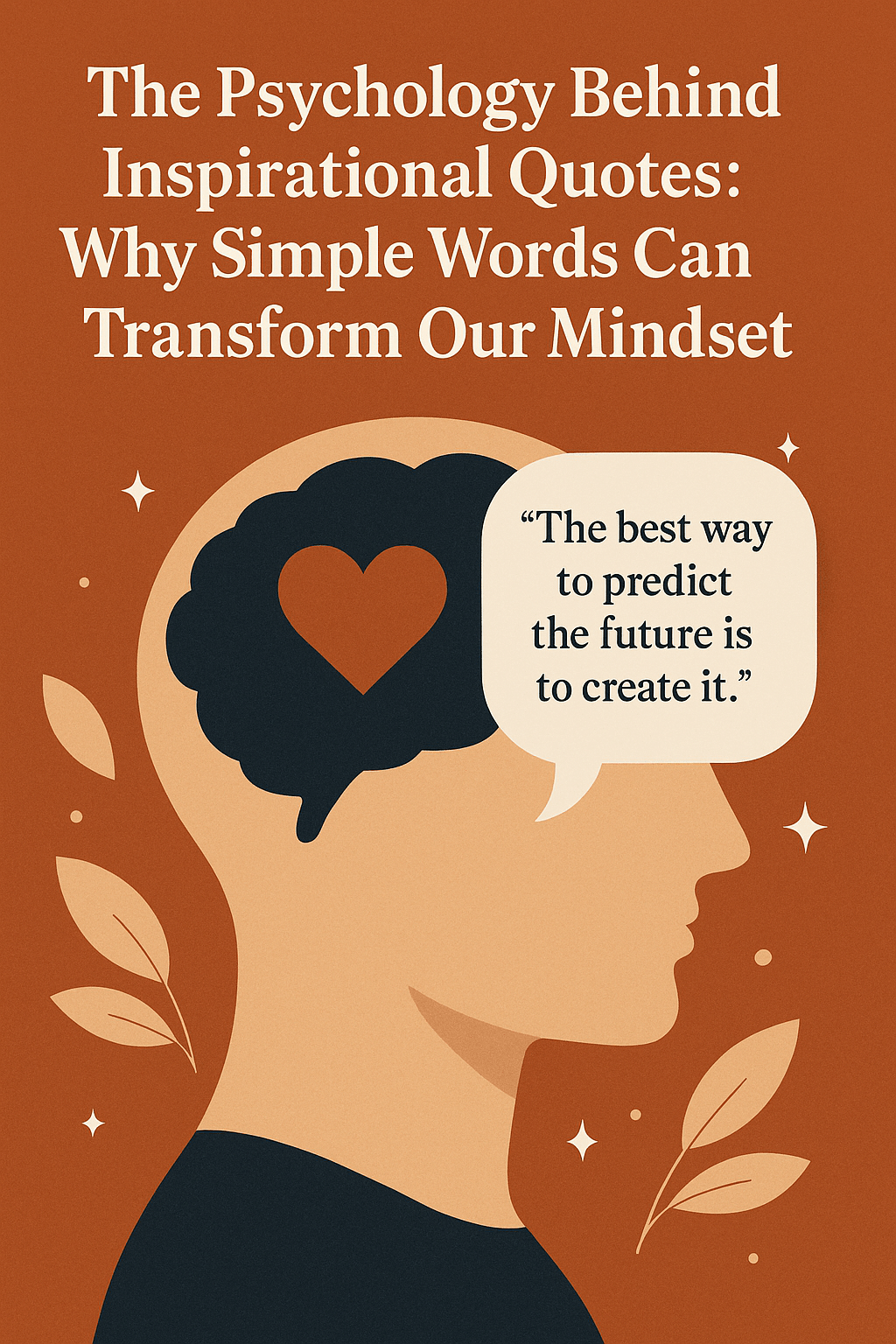
The Psychology Behind Inspirational Quotes: Why Simple Words Can Transform Our Mindset
The Psychology Behind Inspirational Quotes: Why Simple Words Can Transform Our Mindset
In an age of information overload, where complex theories and lengthy self-help books compete for our attention, there's something remarkably enduring about the simple inspirational quote. From Abraham Lincoln's "The best way to predict the future is to create it" to Maya Angelou's "If you don't like something, change it. If you can't change it, change your attitude," these bite-sized pieces of wisdom continue to motivate millions of people across cultures and generations.
But what makes a few carefully chosen words so psychologically powerful? Why do we find ourselves returning to the same quotes during difficult times, sharing them on social media, or even tattooing them permanently on our bodies? The answer lies in a complex interplay of cognitive, emotional, and social psychological mechanisms that reveal fundamental truths about how our minds work.
Understanding the psychology behind inspirational quotes isn't just an academic exercise—it's a window into human motivation, resilience, and our perpetual search for meaning. By examining the science behind why these quotes resonate so deeply, we can better understand not only how language shapes our thoughts and behaviors, but also how we can harness this knowledge to improve our own well-being and that of others.
The Science of Motivation and Meaning-Making
At the heart of every effective inspirational quote lies a fundamental psychological principle: the human need for motivation and meaning. Psychologist Viktor Frankl, a Holocaust survivor and the founder of logotherapy, argued that the primary human drive is not pleasure or power, but the search for meaning. This concept helps explain why inspirational quotes that speak to purpose and significance tend to resonate so powerfully.
When we encounter an inspirational quote that aligns with our values or aspirations, it activates what psychologists call the "meaning-making system"—our brain's natural tendency to create coherent narratives about our experiences and place in the world. This system is constantly working to help us understand not just what happens to us, but why it matters and how it fits into the larger story of our lives.
The brevity of inspirational quotes actually enhances their effectiveness in this meaning-making process. Research in cognitive psychology has shown that our brains are naturally drawn to simple, clear patterns and messages. When complex life situations are distilled into concise, memorable phrases, they become easier to internalize and apply. This is partly due to what psychologists call the "processing fluency effect"—we tend to judge information that is easy to process as more truthful and valuable.
Furthermore, inspirational quotes often employ what psychologists term "approach motivation"—they orient us toward positive goals and possibilities rather than away from negative outcomes. This type of motivation is associated with increased creativity, persistence, and overall well-being. When a quote like "Every expert was once a beginner" reframes failure and inexperience as natural steps in a journey rather than permanent limitations, it activates our approach motivation system and encourages continued effort.
The timing of when we encounter inspirational quotes also plays a crucial role in their psychological impact. During periods of uncertainty, stress, or transition, our minds are particularly receptive to messages that provide direction and hope. This state of heightened receptivity, known as "psychological readiness," makes us more likely to adopt and internalize motivational messages that we might otherwise dismiss during more stable periods.
Cognitive Mechanisms at Play
The effectiveness of inspirational quotes can be understood through several key cognitive mechanisms that influence how we process and respond to information. One of the most important is the concept of cognitive availability—the ease with which we can recall and use information when we need it.
Inspirational quotes are particularly well-designed for cognitive availability. Their brevity makes them easy to memorize, their rhythmic or alliterative qualities make them catchy, and their emotional content makes them memorable. When we face challenges, these easily recalled phrases can serve as immediate cognitive resources, providing quick access to motivational frameworks without requiring extensive mental processing.
Another crucial mechanism is what psychologists call "cognitive reframing"—the ability to reinterpret situations in more positive or productive ways. Many inspirational quotes function as reframing tools, offering alternative perspectives on common challenges. For example, the quote "Failure is not the opposite of success; it's part of success" provides a cognitive framework that transforms potentially discouraging experiences into stepping stones toward achievement.
The psychological concept of "self-efficacy"—our belief in our ability to achieve goals and handle challenges—is also central to understanding why inspirational quotes work. Quotes that emphasize personal agency and capability ("You are stronger than you think") can boost self-efficacy by providing external validation of our inner resources. This boost in self-efficacy often becomes self-fulfilling, as people who believe they can succeed are more likely to persist through difficulties and ultimately achieve their goals.
Inspirational quotes also tap into what cognitive scientists call "metacognition"—thinking about thinking. The best quotes don't just provide information; they help us become more aware of our thought patterns and mental habits. When we read "Your thoughts become your reality," we're being prompted to examine our internal dialogue and consider how our mental habits might be shaping our experiences.
The phenomenon of "confirmation bias" also plays a role in how we respond to inspirational quotes. We tend to be drawn to quotes that confirm our existing beliefs about what's possible or important, while filtering out messages that challenge our worldview. While this can sometimes limit growth, it also means that the quotes we choose to embrace often reflect our deeper values and aspirations, making them particularly powerful tools for self-motivation.
The Role of Social and Cultural Factors
Inspirational quotes don't exist in a vacuum—they're deeply embedded in social and cultural contexts that significantly influence their psychological impact. The social psychology principle of "social proof" helps explain why quotes attributed to respected figures or shared widely on social media platforms tend to carry more weight than anonymous sayings.
When we see that thousands of people have shared a particular quote, or when it's attributed to someone we admire, we unconsciously infer that it must contain valuable wisdom. This social validation can amplify the quote's psychological impact, making us more likely to internalize its message and apply it to our own lives. The phenomenon is so powerful that research has shown people will rate the same statement as more meaningful when it's attributed to a famous person rather than an unknown source.
Cultural context also shapes which types of inspirational quotes resonate in different societies. Individualistic cultures tend to favor quotes that emphasize personal achievement, self-reliance, and individual potential ("The only person you are destined to become is the person you decide to be"). Collectivistic cultures, by contrast, often respond more strongly to quotes that emphasize community, harmony, and interconnectedness ("We rise by lifting others").
The digital age has created new social dynamics around inspirational quotes. Social media platforms have transformed quotes from private sources of motivation into public declarations of values and aspirations. When someone shares an inspirational quote online, they're not just seeking personal motivation—they're also signaling their identity, values, and current emotional state to their social network. This social dimension can enhance the quote's psychological impact by creating accountability and community around shared aspirations.
The concept of "emotional contagion"—the tendency for emotions to spread between people—also helps explain why inspirational quotes can be so powerful in group settings. When a motivational quote is shared in a team meeting, classroom, or online community, the positive emotions it generates can spread throughout the group, creating a collective sense of optimism and possibility that reinforces the message for each individual.
However, social factors can also create pressure around inspirational quotes. The expectation to always be positive and motivated, often called "toxic positivity," can make some people feel inadequate when they struggle to embody the optimistic messages they encounter. This highlights the importance of understanding inspirational quotes as tools rather than requirements, and recognizing that their effectiveness depends partly on timing and individual readiness.
Neurological Underpinnings
Recent advances in neuroscience have begun to illuminate the brain mechanisms underlying our response to inspirational messages. When we read an inspirational quote that resonates with us, several neural networks activate in coordinated ways that help explain the psychological effects we experience.
The brain's reward system, centered around the neurotransmitter dopamine, plays a crucial role in our response to motivational messages. When we encounter a quote that aligns with our goals or provides hope for positive outcomes, it can trigger a mild dopamine release that creates feelings of pleasure and motivation. This neurochemical response helps explain why we often feel energized and optimistic immediately after reading an inspiring message.
The prefrontal cortex, responsible for executive functions like planning and goal-setting, also shows increased activity when we engage with motivational content. Neuroimaging studies have found that exposure to positive, future-oriented messages activates brain regions associated with prospective thinking and goal pursuit. This suggests that inspirational quotes don't just make us feel good—they actually prime our brains for productive action.
Mirror neurons, which fire both when we perform an action and when we observe others performing the same action, may also contribute to the power of inspirational quotes. When we read about someone else's triumph or transformation, these neurons help us mentally simulate similar experiences, making success feel more achievable and concrete. This is why quotes that tell stories of overcoming adversity ("I have not failed. I've just found 10,000 ways that won't work") can be particularly motivating.
The brain's language processing centers also play a specialized role in how we respond to inspirational quotes. Research has shown that metaphorical language, which is common in motivational quotes, activates not just language areas but also sensory and motor regions associated with the metaphor's content. When we read "Life is a journey, not a destination," our brains activate areas associated with movement and spatial navigation, making the abstract concept more concrete and memorable.
Neuroplasticity—the brain's ability to reorganize and form new neural connections—provides another lens for understanding the long-term effects of inspirational quotes. Regular exposure to positive, growth-oriented messages can literally reshape neural pathways, making optimistic and resilient thinking patterns more automatic over time. This suggests that the benefits of inspirational quotes may extend far beyond momentary motivation to create lasting changes in how we think and respond to challenges.
The role of memory systems is also crucial. The brain's episodic memory system, which stores personal experiences, can be activated when we read quotes that remind us of our own past successes or meaningful moments. This connection between the quote and personal memory can make the message feel more relevant and powerful, as it taps into our own evidence base for possibility and resilience.
Why Some Quotes Resonate More Than Others
Not all inspirational quotes are created equal. While one person might find deep meaning in "Everything happens for a reason," another might find the same phrase shallow or even offensive. Understanding why certain quotes resonate with some people but not others reveals important insights about individual psychology and the factors that determine a quote's effectiveness.
Personal relevance is perhaps the most important factor. Quotes that speak directly to our current challenges, goals, or life stage tend to have the strongest psychological impact. A student facing academic pressure might find motivation in "Success is not final, failure is not fatal: it is the courage to continue that counts," while someone dealing with loss might resonate more with "Grief is the price we pay for love." This relevance creates what psychologists call "personal significance," making the message feel like it was crafted specifically for our situation.
Cognitive complexity also influences quote effectiveness. People with different levels of education, life experience, and cognitive preferences respond to different types of messaging. Some individuals prefer simple, direct statements ("Just do it"), while others are drawn to more nuanced or paradoxical messages ("The only way out is through"). This preference often reflects deeper personality traits like need for cognition—the tendency to enjoy thinking deeply about complex ideas.
The psychological concept of "readiness to change" plays a crucial role in determining which quotes resonate. People in different stages of personal transformation respond to different types of motivational messages. Those just beginning to consider change might respond to quotes that raise awareness ("The definition of insanity is doing the same thing over and over and expecting different results"), while those already committed to change might prefer action-oriented messages ("A journey of a thousand miles begins with a single step").
Attachment style—our characteristic way of forming and maintaining relationships—also influences quote preferences. People with secure attachment styles might gravitate toward quotes about growth and possibility, while those with anxious attachment might prefer quotes that offer reassurance and acceptance. Understanding these individual differences helps explain why the same quote can feel inspiring to one person and empty to another.
Values alignment is another critical factor. Quotes that reflect our core values and beliefs about what matters in life tend to resonate more strongly than those that conflict with our worldview. Someone who values achievement might be motivated by "Excellence is never an accident," while someone who prioritizes relationships might prefer "Be kind, for everyone you meet is fighting a hard battle."
The linguistic features of quotes also affect their resonance. Research has shown that people respond differently to various rhetorical devices like alliteration, rhythm, and parallelism. Some find these features make quotes more memorable and impactful, while others might perceive them as manipulative or artificial. Cultural background and language exposure can influence these preferences significantly.
The Dark Side: When Inspirational Quotes Fall Short
While inspirational quotes can be powerful tools for motivation and meaning-making, it's important to acknowledge their limitations and potential negative effects. Understanding when and why quotes fail to help—or even cause harm—provides a more complete picture of their psychological impact.
One significant limitation is the oversimplification of complex problems. Mental health challenges, systemic inequalities, and trauma can't be resolved simply by changing one's mindset, yet some inspirational quotes implicitly suggest otherwise. Messages like "Happiness is a choice" can be harmful to people dealing with depression, anxiety, or other mental health conditions, as they may feel blamed for their suffering or inadequate for not being able to simply "choose" to feel better.
The phenomenon of "spiritual bypassing"—using positive thinking to avoid dealing with difficult emotions or situations—can be enabled by certain types of inspirational quotes. When people use motivational messages to suppress rather than process challenging feelings, it can prevent genuine healing and growth. The pressure to maintain a positive attitude can become another source of stress rather than a solution to existing problems.
Inspirational quotes can also contribute to what researchers call "self-enhancement bias"—the tendency to overestimate our abilities and likelihood of success. While some optimism is healthy and motivating, unrealistic expectations can lead to poor decision-making, inadequate preparation, and eventual disappointment. Quotes that promote extreme positive thinking without acknowledging the role of effort, skill, and circumstance can set people up for failure.
The commercialization of inspirational quotes has created additional problems. When motivation becomes a product to be sold rather than genuine wisdom to be shared, it can lose its authenticity and effectiveness. The proliferation of generic, mass-produced inspirational content can dilute the impact of truly meaningful messages and create cynicism toward motivational communication in general.
Cultural insensitivity is another concern. Many popular inspirational quotes reflect specific cultural values and assumptions that may not apply universally. Western emphasis on individual achievement and self-reliance, for example, can feel alienating or inappropriate to people from cultures that prioritize community and interdependence.
The timing of exposure to inspirational quotes also matters significantly. Messages that might be helpful during periods of growth and possibility can feel dismissive or inadequate during times of acute crisis or grief. Someone who has just experienced a major loss might find quotes about "everything happening for a reason" deeply offensive rather than comforting.
Finally, the passive consumption of inspirational quotes without corresponding action can create an illusion of progress that actually inhibits real change. When people mistake feeling motivated for being motivated, they may experience a false sense of accomplishment that reduces their drive to take concrete steps toward their goals.
Practical Applications and Effectiveness
Understanding the psychology behind inspirational quotes opens up numerous possibilities for using them more effectively in various contexts. Whether in education, therapy, leadership, or personal development, this knowledge can help maximize their positive impact while minimizing potential negative effects.
In educational settings, teachers and coaches can use inspirational quotes strategically to build growth mindset and resilience. Research has shown that messages emphasizing effort over ability ("Intelligence is not fixed") can improve student performance and persistence. However, effectiveness depends on matching the message to the student's current needs and developmental level. Elementary students might respond better to simple, concrete messages, while older students can handle more complex or abstract concepts.
Therapists and counselors can incorporate inspirational quotes as cognitive tools to help clients reframe negative thought patterns and build self-efficacy. The key is ensuring that quotes complement rather than replace thorough therapeutic work. A quote might serve as a memorable anchor for a therapeutic insight or a reminder of progress made during difficult moments between sessions.
In workplace settings, leaders can use inspirational messaging to create shared vision and maintain morale during challenging periods. However, effectiveness requires authenticity and appropriate timing. Quotes that feel disconnected from organizational reality or are used to dismiss legitimate concerns can backfire, creating cynicism rather than motivation.
For personal development, individuals can curate collections of quotes that speak to their specific goals and challenges. The practice of reflection—thinking deeply about why certain quotes resonate and how they apply to current situations—can enhance their effectiveness. Some people find it helpful to journal about meaningful quotes or use them as meditation focal points.
Digital applications have created new opportunities for personalized quote delivery. Apps that send daily inspirational messages can be effective if they allow for customization based on individual preferences, goals, and current circumstances. However, the passive consumption of generic content is less likely to create lasting impact than active engagement with personally meaningful messages.
The social dimension of inspirational quotes can be leveraged through book clubs, discussion groups, or online communities focused on personal growth. When people share and discuss meaningful quotes together, the collective exploration can deepen understanding and strengthen commitment to positive change.
Research suggests that the most effective use of inspirational quotes involves several key principles: personal relevance, appropriate timing, active engagement rather than passive consumption, balance with realistic goal-setting, and integration with concrete action steps. When these principles are followed, quotes can serve as powerful catalysts for positive change and sustained motivation.
Conclusion
The enduring appeal of inspirational quotes reflects fundamental aspects of human psychology that transcend cultural and temporal boundaries. Our need for meaning, motivation, and hope drives us to seek out messages that can reframe challenges, validate our aspirations, and remind us of our capacity for growth and resilience.
The psychological mechanisms underlying our response to inspirational quotes—from cognitive reframing and self-efficacy to neural reward systems and social validation—reveal the sophisticated ways our minds process and apply motivational information. Understanding these mechanisms helps us appreciate why a few well-chosen words can sometimes accomplish what lengthy explanations cannot.
However, this understanding also reveals the importance of approaching inspirational quotes with nuance and wisdom. They are tools, not panaceas—most effective when matched to individual needs, circumstances, and readiness for change. Their power lies not in their ability to solve problems through positive thinking alone, but in their capacity to shift perspective, provide cognitive resources, and inspire action toward meaningful goals.
As we navigate an increasingly complex world filled with challenges that require both individual resilience and collective action, inspirational quotes can serve as valuable allies in maintaining hope and motivation. But their true value emerges when we engage with them thoughtfully, use them to complement rather than replace substantive efforts toward change, and recognize them as one part of a larger toolkit for human flourishing.
The psychology behind inspirational quotes ultimately tells us something profound about human nature: we are meaning-making beings who thrive on hope, connection, and the belief that positive change is possible. In a world that can often feel overwhelming or discouraging, the simple act of finding wisdom and encouragement in carefully crafted words represents an enduring form of resilience—a testament to our remarkable capacity to find light in darkness and strength in vulnerability.
Whether scribbled on a sticky note, shared on social media, or quietly contemplated during difficult moments, inspirational quotes will likely continue to play a role in human motivation and meaning-making for generations to come. By understanding the psychology behind their appeal, we can harness their power more effectively while remaining grounded in the realities of genuine growth and positive change.
Explore Quote Collections
Books & Knowledge
Explore the best quotes about the power of reading, the magic of libraries, book collecting, literary wisdom, and the timeless bond between reader and author.
Friendship
Explore the best friendship quotes about true friends, loyalty, trust, betrayal, love, and lifelong bonds. Browse curated quote collections by theme.

Life
Explore the deepest questions of existence. A curated collection of quotes on the journey of life, the pursuit of wisdom, the beauty of struggle, and the acceptance of mortality.
Persistence & Progress
Discover the power of steady progress. Explore curated quotes on overcoming challenges, simplifying complex problems, staying focused, and the art of getting things done.
You Might Also Like

Patrick Wright
Software engineer and creator of Quotesperation. I curate wisdom from history's greatest minds to inspire and guide modern life. When I'm not collecting quotes, I'm writing about technology and finding connections between timeless wisdom and today's challenges.