AO

Andrew Oswald


================

Full Name and Common Aliases


-----------------------------

Andrew Oswald is a British economist and professor who has gained international recognition for his groundbreaking research on the impact of socioeconomic factors on health and well-being.

Birth and Death Dates


-----------------------

Born in 1964, Oswald's early life and academic pursuits laid the foundation for his future success as a leading expert in his field.

Nationality and Profession(s)


-----------------------------

Oswald is a British economist and professor. His work has spanned various institutions, including the University of Warwick and the University of Edinburgh, where he currently holds a chair in economics.

Early Life and Background


---------------------------

Growing up in the UK, Oswald's interest in economics was sparked at an early age. He pursued his passion for understanding human behavior and its relationship to economic systems throughout his academic career. After completing his undergraduate studies, Oswald went on to earn a Ph.D. in economics from the University of Cambridge.

Major Accomplishments


-------------------------

Oswald's research has focused on the interplay between socioeconomic factors and health outcomes. His work has challenged traditional views on the relationship between income, happiness, and well-being. Some notable achievements include:

Economist of the Year: Oswald was awarded this prestigious title in 2003 for his contributions to the field of economics.
Influential Research: He has published numerous papers that have significantly impacted policy discussions on poverty, inequality, and healthcare.

Notable Works or Actions


---------------------------

Oswald's most notable works include:

"Happiness and Economic Growth: The Unusual Case for Negative Income Tax Intercepts" (1997): This paper explored the relationship between income, happiness, and economic growth, challenging traditional views on the subject.
"Socioeconomic Determinants of Health: A Study of the Relationship Between Income Inequality and Mortality in 16 British Cities" (2001): Oswald's research on the impact of income inequality on mortality rates has been widely cited and influential.

Impact and Legacy


----------------------

Andrew Oswald's work has had a profound impact on the field of economics. His findings have influenced policy discussions worldwide, with far-reaching implications for poverty reduction, healthcare, and social welfare programs. As a leading expert in his field, Oswald continues to shape the conversation around socioeconomic factors and their relationship to human well-being.

Why They Are Widely Quoted or Remembered


-----------------------------------------

Andrew Oswald's groundbreaking research has left an indelible mark on the field of economics. His commitment to understanding the complex relationships between income, happiness, and health has inspired a new generation of economists and policymakers. As a result, he is widely quoted and remembered for his pioneering work in challenging traditional views on socioeconomic factors and their impact on human well-being.

His contributions to the field have been recognized through numerous awards and accolades, cementing his status as one of the most influential economists of our time.

Quotes by Andrew Oswald

"
The resilience of Western economies to recent oil shocks has been remarkable.
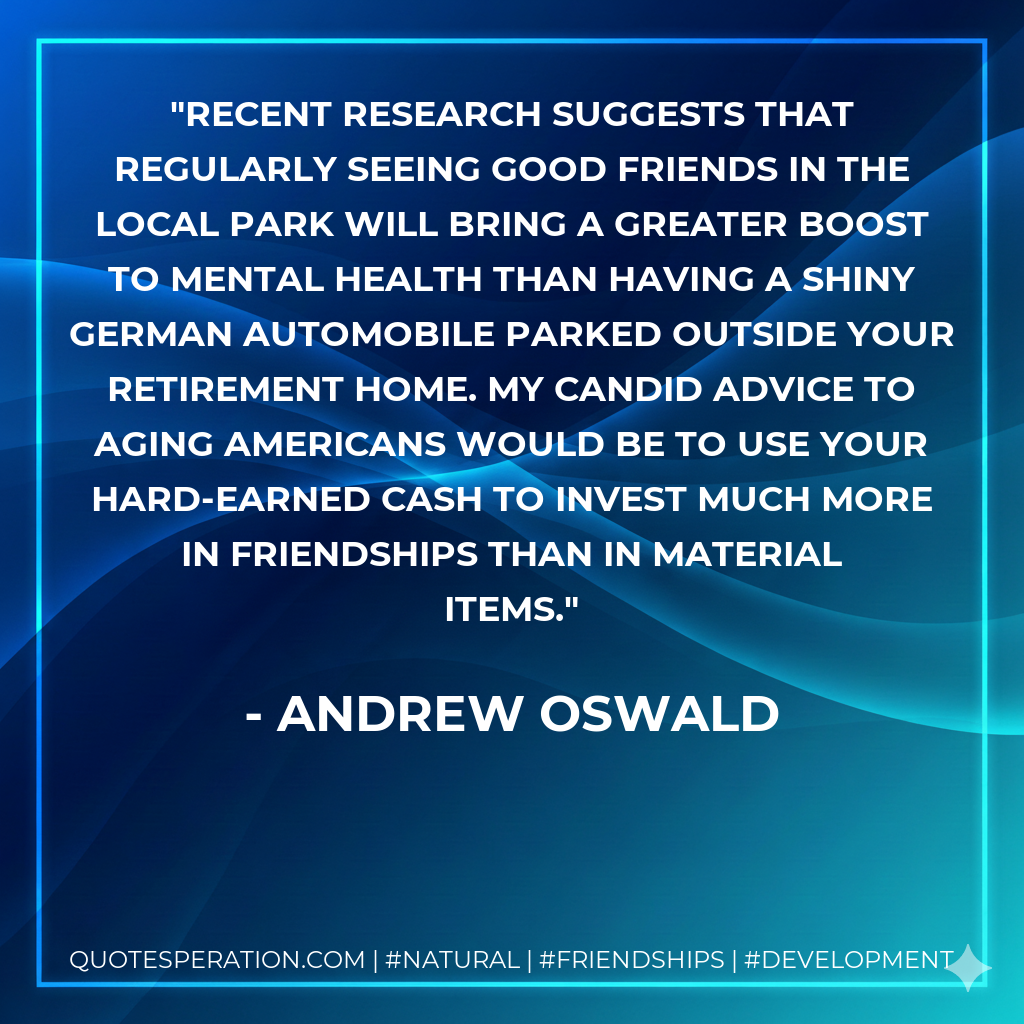
Recent research suggests that regularly seeing good friends in the local park will bring a greater boost to mental health than having a shiny German automobile parked outside your retirement home. My candid advice to aging Americans would be to use your hard-earned cash to invest much more in friendships than in material items.
"
Recent research suggests that regularly seeing good friends in the local park will bring a greater boost to mental health than having a shiny German automobile parked outside your retirement home. My candid advice to aging Americans would be to use your hard-earned cash to invest much more in friendships than in material items.
"
What you have in the bank, according to the data, does not matter all that much. What really matters is the gap between what is there and what you think you ought to have. Millionaires can feel relatively poor.
"
Political feelings are much less independently chosen than people realize. Children mold their parents.