Émilie Du Châtelet
=====================

Full Name and Common Aliases


------------------------------

Émilie Du Châtelet was born as Émilie du Châtelet on December 17, 1706, in Paris, France. She is often referred to as Madame Du Châtelet, a title that reflects her married status.

Birth and Death Dates


-------------------------

December 17, 1706 – September 10, 1749

Nationality and Profession(s)


-------------------------------

French philosopher, mathematician, physicist, and translator. She was a prominent figure in the Enlightenment era, known for her contributions to various fields, including mathematics, physics, and philosophy.

Early Life and Background


---------------------------

Émilie Du Châtelet was born into a noble family. Her father, Louis-Nicolas Le Tonnelier de Breteuil, Marquis de Bouillac, was a government minister. Despite the privileges that came with her birth, Émilie's early life was marked by tragedy when she lost her mother at a young age. She received an excellent education, which laid the foundation for her future intellectual pursuits.

Major Accomplishments


-------------------------

Émilie Du Châtelet's academic prowess and dedication to learning led to numerous accomplishments:

Mathematical Contributions: Her work on mathematics, particularly in the field of calculus, was groundbreaking. She translated Sir Isaac Newton's _Principia Mathematica_ into French, adding her own commentaries that provided significant insights into the subject.
Translation and Commentary: In addition to translating Newton's _Principia_, she also worked on a comprehensive commentary on the work, which not only clarified complex concepts but also provided her own original contributions to the field of mathematics.
Scientific Research: Du Châtelet conducted extensive research in physics, particularly in the areas of thermodynamics and fluid dynamics. Her work laid the groundwork for later scientists, including Antoine Lavoisier.

Notable Works or Actions


-----------------------------

Some of her notable works include:

Institutions de Physique (1742) - A comprehensive textbook on physics that provided a clear explanation of various scientific concepts.
Principes Mathématiques de la Philosophie Naturelle (1756, published posthumously) - A book that outlined the fundamental principles of natural philosophy.

Impact and Legacy


-------------------------

Émilie Du Châtelet's impact on science and mathematics cannot be overstated. Her work influenced several notable scientists, including Voltaire and Benjamin Franklin. She was a pioneering figure in the Enlightenment era, paving the way for future generations of women in STEM fields:

Role Model: Du Châtelet's determination to pursue her intellectual interests, despite societal expectations that she should focus on domestic duties, made her an inspiration to many.
* Scientific Contributions: Her original contributions to mathematics and physics expanded our understanding of the natural world.

Why They Are Widely Quoted or Remembered


---------------------------------------------

Émilie Du Châtelet's quotes often reflect her passion for learning and her commitment to using knowledge as a force for good. She believed that education should be accessible to all, regardless of social class:

> "It is the duty of those who have the gift of knowledge to share it with others."
>
> — Émilie Du Châtelet

Quotes by Émilie Du Châtelet

"
To be happy, one must rid oneself of prejudice, be virtuous, healthy, and have a capacity for enjoyment and for passion...
"
Self-love is always the mainspring, more or less concealed, of our actions; it is the wind which swells the sails, without which the ship could not go.
"
Let us choose for ourselves our path in life, and let us try to strew that path with flowers.
"
If I were king, I would redress an abuse which cuts back, as it were, one half of human kind. I would have women participate in all human rights, especially those of the mind.
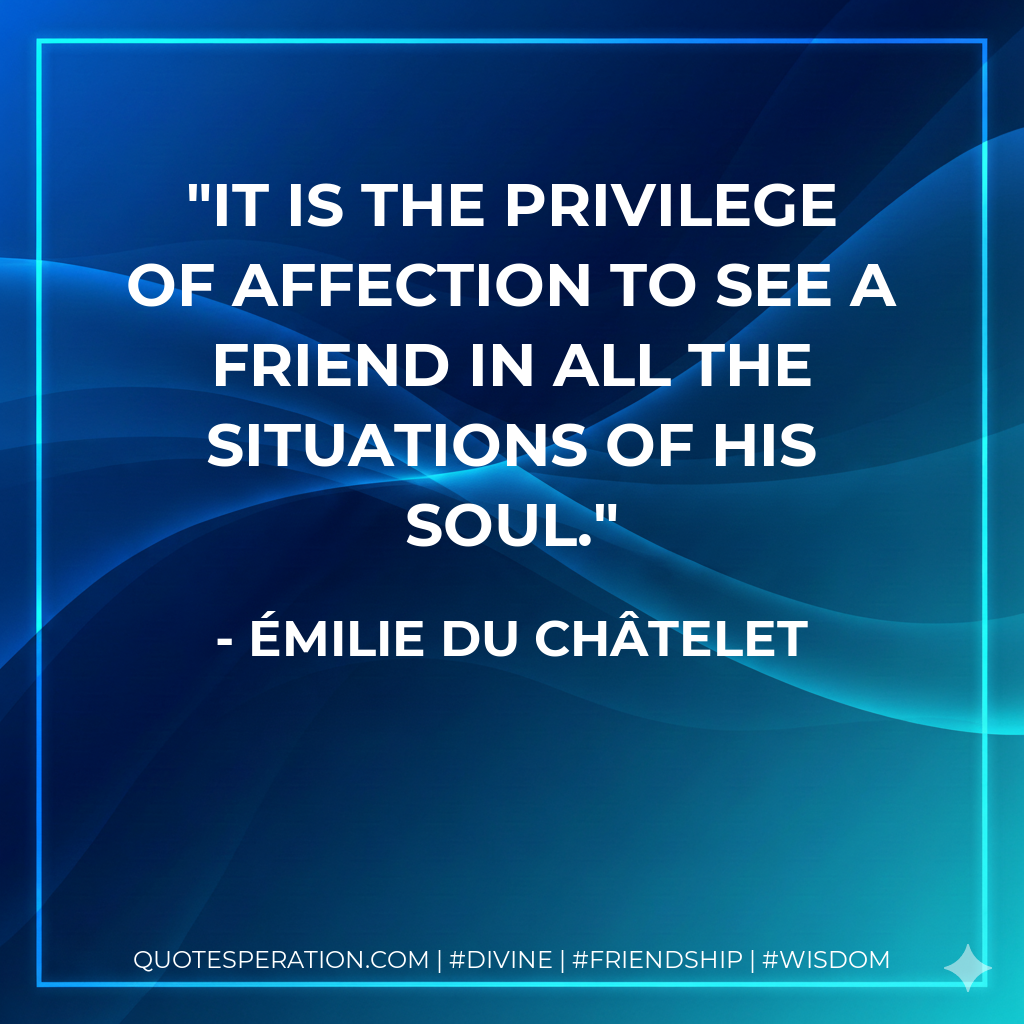
It is the privilege of affection to see a friend in all the situations of his soul.
"
It is the privilege of affection to see a friend in all the situations of his soul.
"
Let us be certain of who we want to be. Let us choose for ourselves our path in life, and let us try to strew that path with flowers.