Francesco Petrarca
Francesco Petrarca
Full Name and Common Aliases
Francesco Petrarca, also known as Petrarch, was a renowned Italian poet and scholar of the Renaissance period. His full name is Francesco Petrarca, but he is commonly referred to by his nickname Petrarch, which is derived from his family's ancestral home in Petrarca, near Padua.
Birth and Death Dates
Francesco Petrarca was born on July 20, 1304, in Arezzo, Italy. He passed away on July 18, 1374, in Arquà Pellegrino, Italy.
Nationality and Profession(s)
Petrarch's nationality is Italian, and his primary profession was that of a poet, although he also worked as a lawyer, philosopher, and historian. His contributions to the Renaissance movement are invaluable, and he is considered one of the greatest poets of all time.
Early Life and Background
Petrarch was born into a family of lawyers, which instilled in him a strong interest in law and literature from an early age. He received his education in Avignon, where he studied law, philosophy, and classical languages. During this period, Petrarca became fascinated with the works of ancient Greek and Roman writers, particularly Cicero and Virgil.
Major Accomplishments
Petrarch's major accomplishments are numerous and varied. Some of his most notable achievements include:
Developing the concept of humanism: Petrarch is credited with laying the foundations for the Renaissance movement by emphasizing the importance of individualism, reason, and classical learning.
Rediscovering Latin poetry: Petrarca was instrumental in reviving interest in Latin poetry during the Middle Ages. His own works helped to popularize the genre among scholars and intellectuals.
Inspiring future generations: Petrarch's literary legacy extends far beyond his own lifetime. He influenced many notable figures, including Dante Alighieri and Geoffrey Chaucer.Notable Works or Actions
Some of Petrarca's most notable works include:
"Africa": This epic poem is considered one of Petrarch's masterpieces, chronicling the history of Rome from its founding to the reign of Julius Caesar.
* "Sonnet 134": This sonnet, also known as "As old age upon me creeps," showcases Petrarca's skill in expressing emotions and ideas through poetry.
Impact and Legacy
Francesco Petrarca's impact on literature and culture is immeasurable. His emphasis on humanism, individualism, and classical learning helped to shape the intellectual landscape of the Renaissance. Today, he remains one of the most widely read and quoted poets in history, with his works continuing to inspire scholars and artists alike.
Why They Are Widely Quoted or Remembered
Petrarch's quotes are frequently referenced due to their timeless wisdom, literary merit, and historical significance. His poetry offers insights into the human experience, exploring themes such as love, beauty, and mortality. As a result, his words continue to resonate with readers across cultures and centuries.
By understanding Petrarca's life, works, and legacy, we can appreciate why he remains an enduring figure in literature and culture.
Quotes by Francesco Petrarca


And what good has all your reading done you? Out of all the things you have read, how much has really stayed in your soul, what roots have grown there that will, in a good time, bring forth fruit? Examine your heart carefully. If you compare the whole of what you know with what you don’t know, you will find that your knowledge is like a small stream dried up in the summer heat compared to the ocean of your ignorance. And even granted that you do know a lot, what difference does it make?


Everything else, every thought, goes fore and forever fades away into the recesses of time, and therein what remains is my soul’s love for you.

Time is our delight and our prison. It binds all human beings together, since we all share the pleasures and burdens of memory, and we all know the anticipation of cherished goals and the dark prospect of personal mortality.
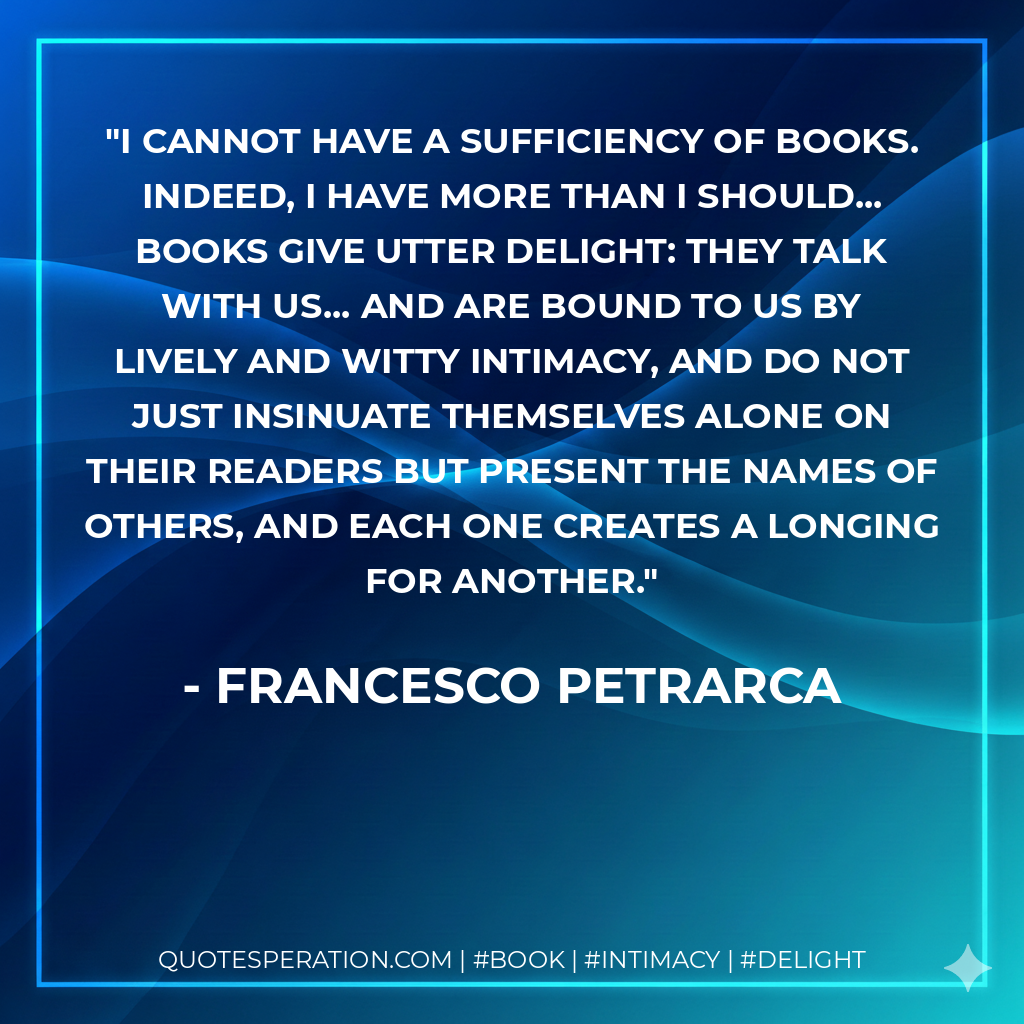
I cannot have a sufficiency of books. Indeed, I have more than I should... Books give utter delight: they talk with us... and are bound to us by lively and witty intimacy, and do not just insinuate themselves alone on their readers but present the names of others, and each one creates a longing for another.

How much I envy you, you greedy earth, who get to clasp the one who’s taken from me, and keep me from the air of her sweet face in which I once found peace from all my war! How.

I stop, then, in my tracks, to recollect the awesome presence that I’ve left behind, the road ahead so long, my life so short, and bow my head and burst out into tears. While.

And what is the use of knowing many things if, when you have learned the dimensions of heaven and earth, the measure of the seas, the courses of stars, the virtues of plants and stones, the secrets of nature, you still don’t know yourself?
