Robert McAfee Brown
Robert McAfee Brown
#### Full Name and Common Aliases
Robert McAfee Brown was a renowned American theologian, educator, and civil rights activist.
Birth and Death Dates
Born on April 17, 1920, in Woodbury, New Jersey, he passed away on November 27, 2001, at the age of 81.
Nationality and Profession(s)
Brown held dual citizenship of the United States and Canada. Throughout his career, he was involved in various professions including:
Theologian
Educator
Civil rights activistEarly Life and Background
Growing up in a conservative Presbyterian family, Brown's early life was marked by a strong Christian upbringing. He attended the College of Wooster, graduating with honors in 1942. During his time at college, he developed a deep interest in theology and social justice.
Major Accomplishments
Brown's significant contributions to society include:
Theologian: His most notable work was "Theology in a New Key," which redefined the concept of Christian theology.
Civil Rights Activist: Brown played a pivotal role in the civil rights movement, particularly during the 1960s. He participated in several significant events, including:
The 1964 Mississippi Freedom Summer
The Selma to Montgomery Marches
Educator: As a professor at San Francisco Theological Seminary and Pacific School of Religion, Brown educated numerous students on theology, ethics, and social justice.
Notable Works or Actions
Some of his notable works include:
"Theology in a New Key"
"Unexpected Ways: A Biographical Journey"
"The Spirit is the Word Made Flesh"
As an advocate for human rights and social justice, Brown continued to engage with issues that were crucial during his time.
Impact and Legacy
Robert McAfee Brown's impact on society extends far beyond his professional accomplishments. His:
Influence on Theology: He redefined Christian theology by introducing a more inclusive and progressive perspective.
Contribution to Civil Rights Movement: His involvement in the civil rights movement helped bring about significant social change, paving the way for future generations of activists.
Educational Legacy: As an educator, Brown trained numerous students who went on to become influential figures in their respective fields.
Why They Are Widely Quoted or Remembered
Robert McAfee Brown is widely quoted and remembered due to his:
Groundbreaking Theological Work: His contributions to Christian theology continue to inspire and shape the field today.
Courageous Stance on Social Justice: Brown's unwavering commitment to human rights and social justice has left a lasting impact on society.
As a testament to his enduring legacy, his work continues to be studied and referenced by scholars and activists alike.
Quotes by Robert McAfee Brown
Observermanship is the art of giving the impression that you are with it even though you don’t know Latin very well.
True patriotism is not worship of our nation but rather, in the light of our worship of the God of justice, to conform our nation’s ways of justice.
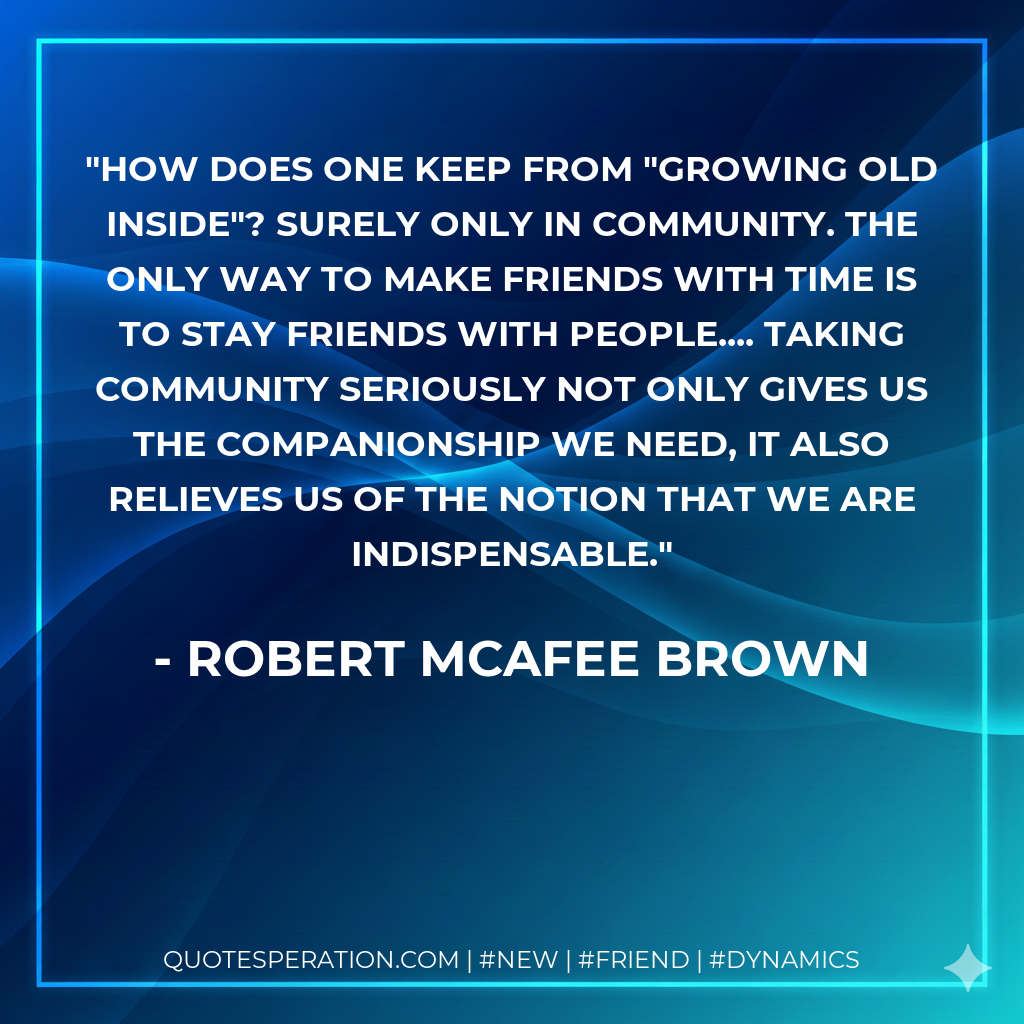
How does one keep from "growing old inside"? Surely only in community. The only way to make friends with time is to stay friends with people.... Taking community seriously not only gives us the companionship we need, it also relieves us of the notion that we are indispensable.
Who we listen to determines what we hear. Where we stand determines what we see. What we do determines who we are.
The Church cannot be content to live in its stained-glass house and throw stones through the picture window of modern culture.
Observermanship is the art of giving the impression that you are with it even though you don't know Latin very well.
To quarrel with God is to pay God the supreme compliment: it is to take God seriously. It is to say that God matters enough to be worth some anger. To be indifferent to God is to pay God the supreme insult. It is to say that nothing of consequence is at stake.
Prayer for many is like a foreign land. When we go there, we go as tourists. Like most tourists, we feel uncomfortable and out of place. Like most tourists, we therefore move on before too long and go somewhere else.
not he whom I find in my path, but rather he in whose path I place myself, he whom I approach and actively seek.